A water-retention roof, a major asset
For decades, annual rainfall in Belgium has ranged from 700 to 900 millimetres. What is changing, however, is its intensity. Downpours with intensities of 60 to 100 millimetres per hour are becoming increasingly frequent. Add to this the high degree of urbanisation, particularly in Flanders and Brussels, which makes it increasingly difficult for rainwater to infiltrate the ground or enter drainage systems, and the problem is clear. This is happening at a time when, in other periods, we have to contend with prolonged heat and drought.
Recent summers have repeatedly confirmed it: weather conditions are becoming more extreme in both directions. These changes mean we need to look at rainwater management from a different perspective. When do we have too much rainwater, and when is there a shortage?
The status quo
At present, in cities, rainwater from all surfaces flows directly into the sewer system. Streets, squares and conventional roofs are designed to drain rainwater as quickly as possible. During heavy downpours, however, this creates a huge peak load on the sewer network. This peak load needs to be reduced, in particular by storing rainwater temporarily and releasing it gradually, or only at a later time.
At the same time, it is clear that rainwater discharged into the sewer network at one point will be needed in abundance again just a few weeks later. During long dry spells, the environment heats up considerably and vegetation can struggle to adapt. It would be beneficial if the rainwater discharged earlier were available again at these times.
Guidelines and requirements
To ease the burden on the sewer network, all municipalities now set guidelines and requirements for rainwater, both for new builds and renovations. These rainwater regulations are generally tailored to the capacity of the sewer network and may, for example, specify a mandatory number of millimetres to be retained, as well as the period after which the retention volume must once again be available to absorb the next downpour. The precise requirements depend on the municipality and the circumstances. Different requirements apply, for example, when rainwater is reused and when it is discharged into the sewer network.
Buffering or retention?
Rainwater tanks and infiltration systems are traditional solutions, but much of the answer can still be found on the roof. Green roofs have been recognised for years as water buffers that make a positive contribution to flood prevention. However, conventional green roofs cannot be “controlled”, which means that at the start of a downpour, it is not possible to know exactly how much water can be buffered.
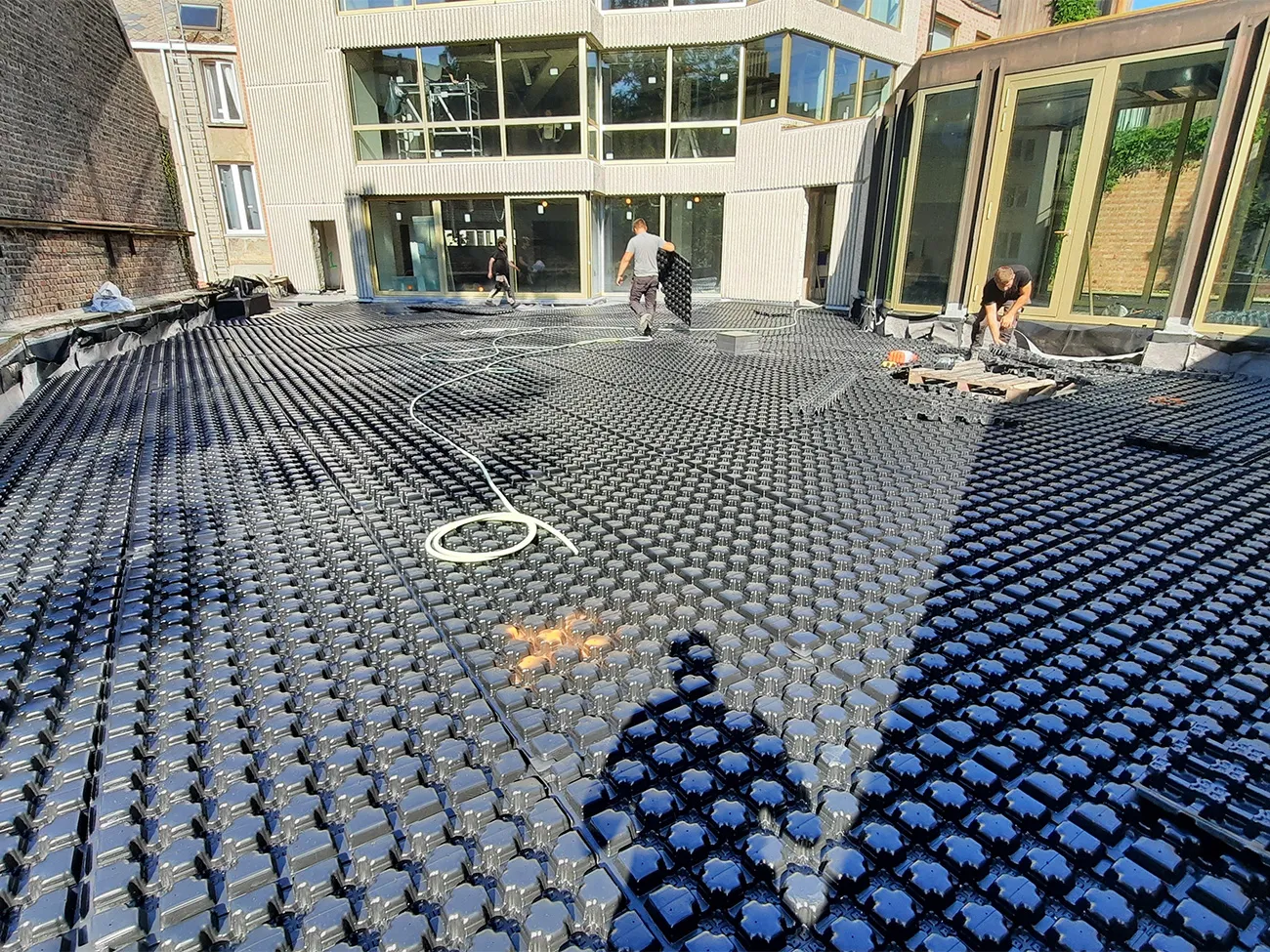
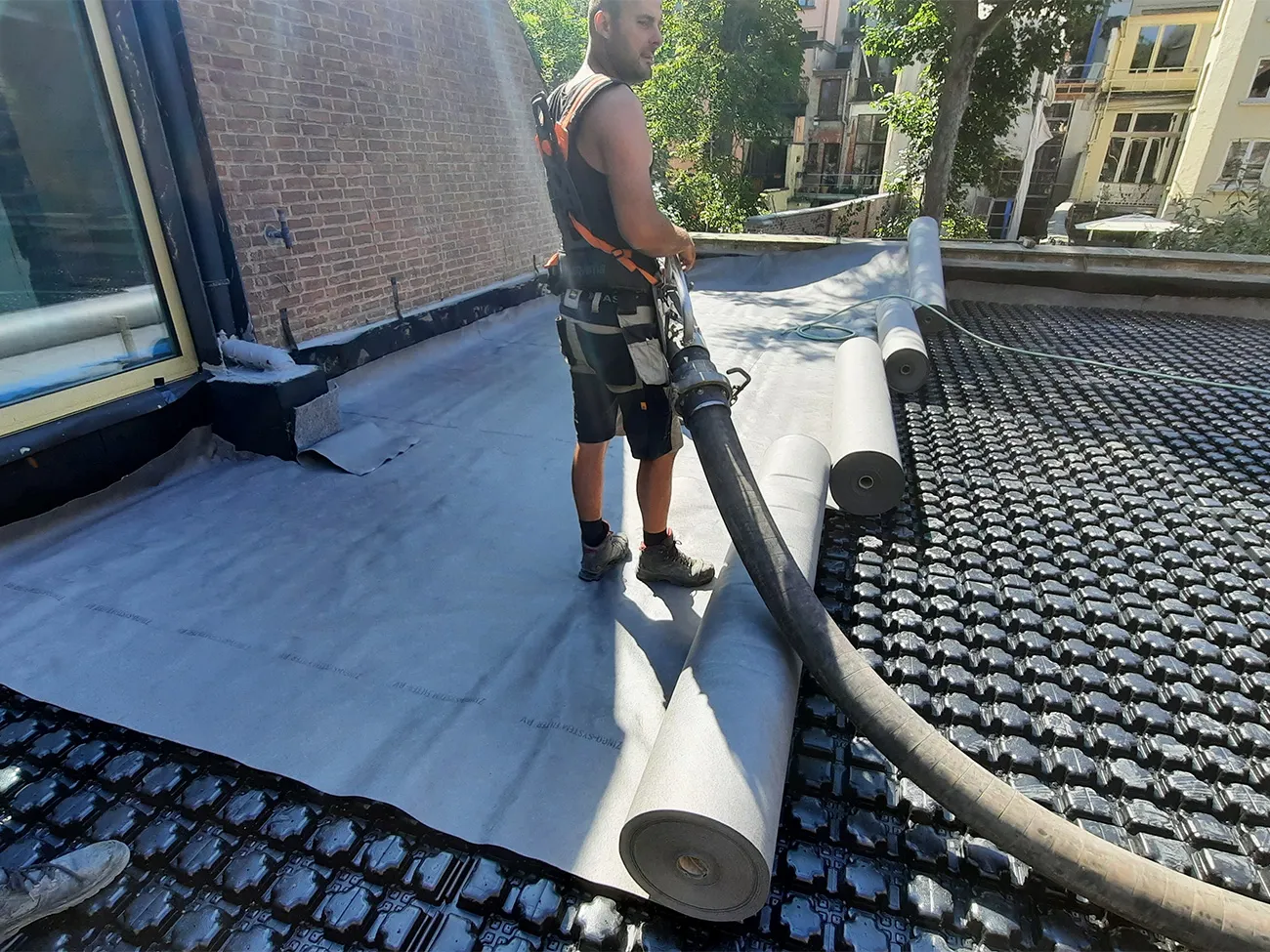
This is indeed possible with a water-retention roof, also known as a blue-green roof. This solution creates an open space beneath the green-roof or roof-garden build-up, where the water level can be controlled as it rises and falls. Rainwater can therefore be managed passively or actively. Please note: a retention roof is only possible on roofs with no slope.
A solution tailored to each project
There is no one-size-fits-all solution for water-retention roofs. Each project has its own specific requirements and circumstances, which together determine the bespoke solution. As with other green roofs, the roof’s load-bearing capacity remains the most important factor. In new buildings, this can be well suited to the requirements of a water-retention roof. In renovations, however, it is obviously decisive, and often limits the solutions available. The requirements and preferences of the municipality and/or the client also determine what is appropriate for the project in question.
As a starting point for project-specific solutions, ZinCo has developed four basic systems for water-retention roofs. Depending on the load-bearing capacity, preferences and requirements, one of these basic systems is selected, then developed and optimised for the specific project. This makes it possible to create a bespoke solution that avoids problems such as oversizing and unnecessary costs.
Question about this story? Ask your question
Keep following this
Get an email when a new story is published. No account needed.
- ThemeGreening dense urban areas
- SubjectNews