Drive through a wadi? You can!
Texte Niels Rouvrois | Photos Acterra
With its TerraViva® growing media, Acterra focuses mainly on driveable lawns and underground tree growing spaces in urban areas. Wadis and permeable surfacing have become essential features in public spaces as climate change accelerates. Private garden owners are also increasingly aware of the need to do their bit. “A wadi can be made much more effective while making better use of space,” explains Bart Geerts, managing director of Acterra, which produces TerraViva® growing media.
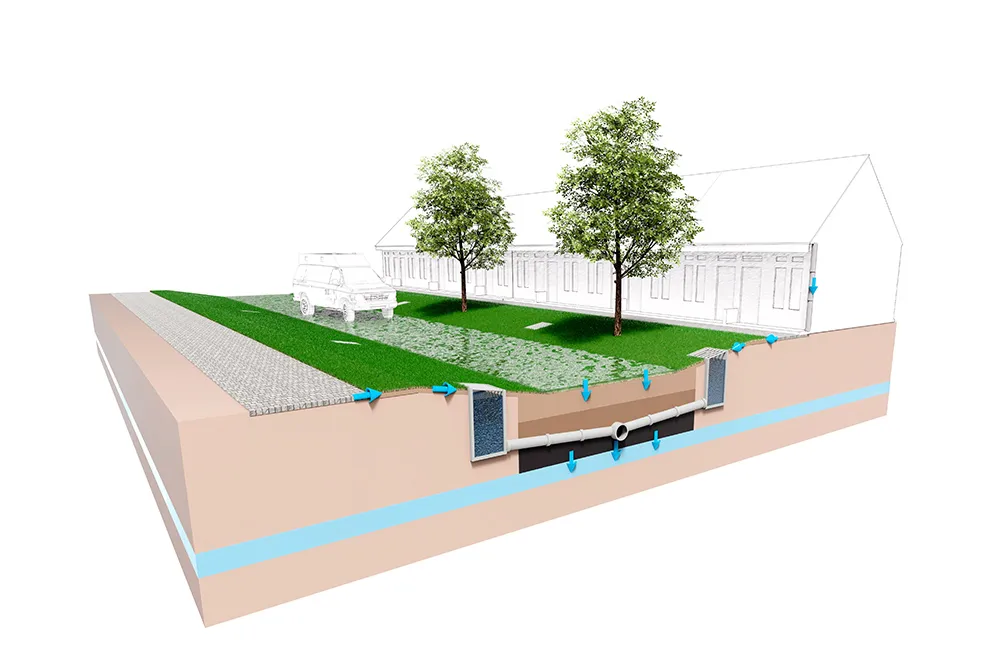
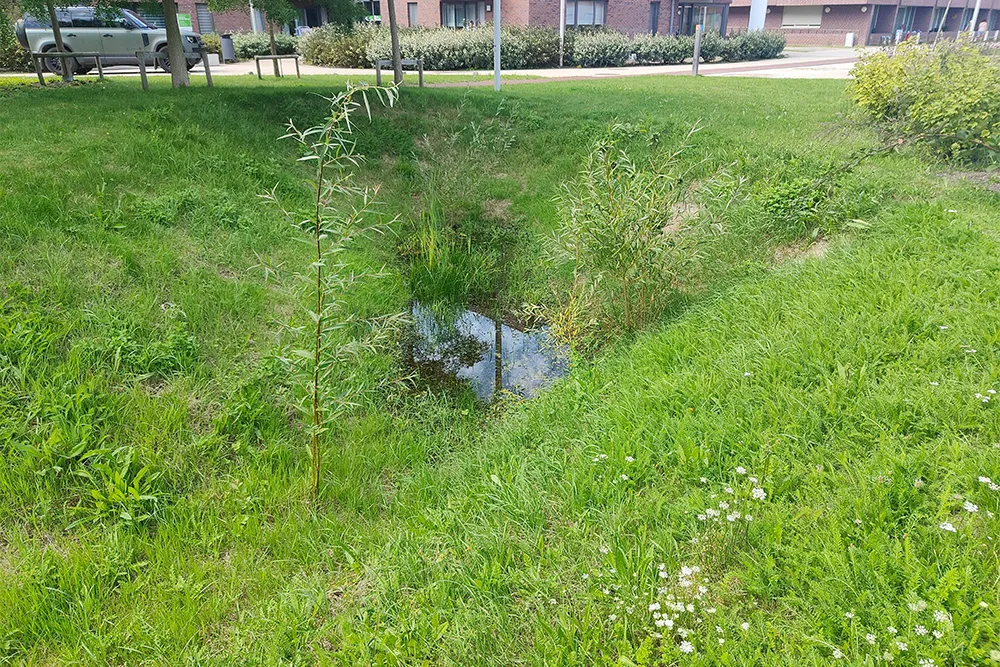
Over the years, Acterra’s driveable lawn mixes have evolved from monotonous grass to mixes made up mainly of plants that can withstand trampling. This matters because the importance of depaving and incorporating more vegetation continues to grow. Every measure taken by public authorities and private individuals to make public spaces, homes and gardens more climate-resilient makes a difference. Wadis (rainwater infiltration swales) are an interesting and already widespread solution. A wadi is a depression or basin filled with gravel and sand that can both store water and allow it to infiltrate.
“In a housing development or industrial site, installing wadis often means making the costly sacrifice of a piece of land,” says Bart Geerts. “The system is designed to let rainwater infiltrate slowly into the subsoil, but in many cases it is built very deep to store enough water, so infiltration takes place over a very small area. As a result, the sides are very steep, making maintenance difficult. After a few years, the wadi becomes overgrown and the vegetation has to be removed with a chainsaw. Particularly in public places, this makes the wadi unsafe and untidy, giving it a negative image.”
Two birds with one stone
“You can walk on a wadi, but it cannot support heavy loads. For example, you cannot drive a car on it, as this compacts the soil and makes it impermeable,” says the website www.blauwgroenvlaanderen.be. Bart Geerts says this is not entirely accurate: “Acterra has developed a solution that combines water infiltration with a driveable surface. It makes better use of the limited space available. For example, if the access road/fire brigade route around a business is built 30 cm lower than the surrounding green space, water can be stored along the entire route. Even when there is water in the wadi, vehicles can drive over it without the risk of subsidence or getting stuck. It’s a win-win for everyone!”
Question about this story? Ask your question
Keep following this
Get an email when a new story is published. No account needed.
- ThemeGreening dense urban areas
- SubjectNews