Natural, biological or physico-chemical? The truth about swimming pond systems
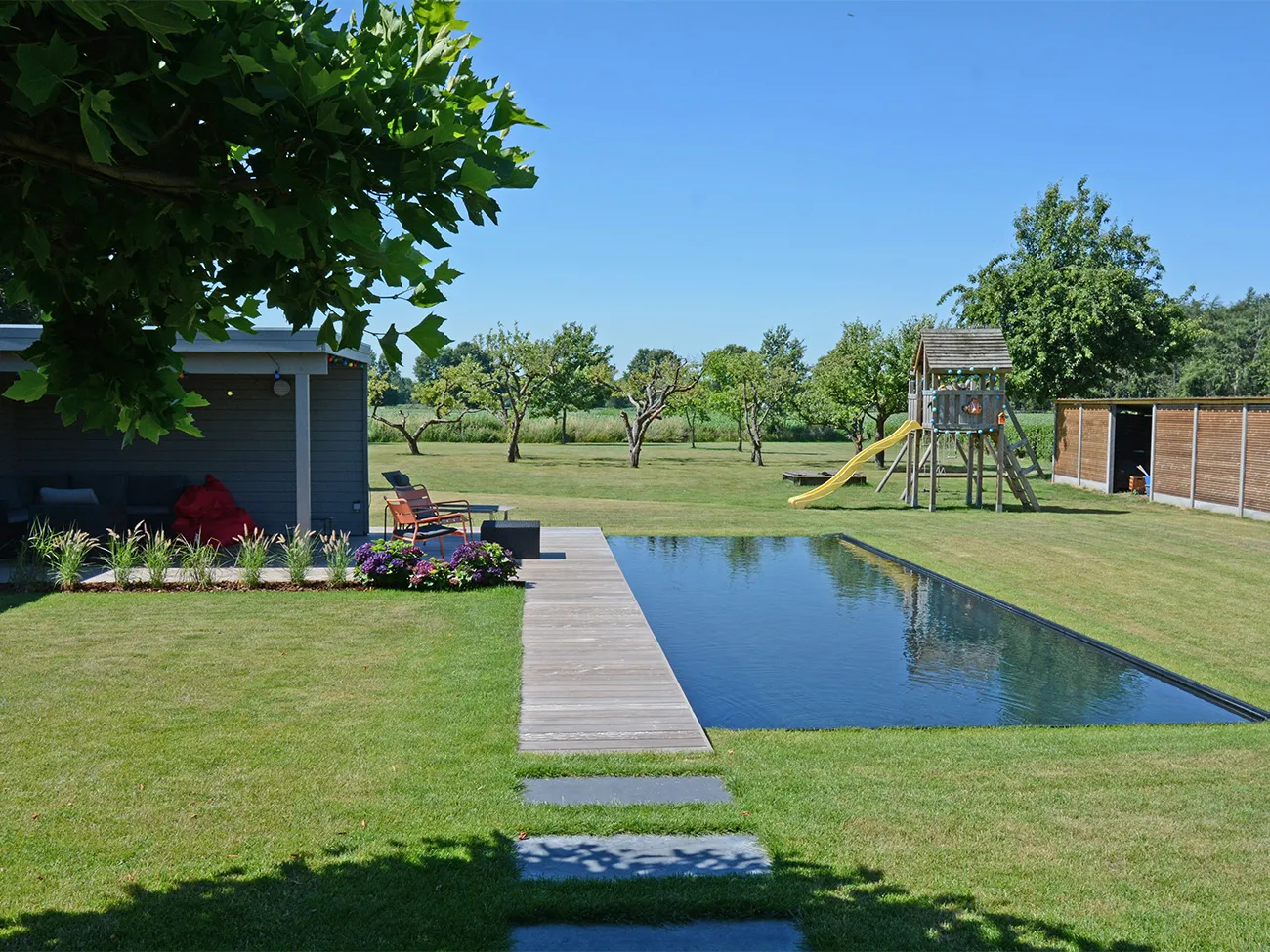
Natural swimming ponds, biological pools, hybrid pools… With all the developments of recent years, it can sometimes be difficult to see the wood for the trees.
In this article, we summarise the main systems in a logical order, from the 100% natural swimming pond to the pool equipped with a physico-chemical treatment system.
Natural swimming pond
In natural swimming ponds, nothing is added to the water. Filtration takes place in planted regeneration zones. There are several systems.
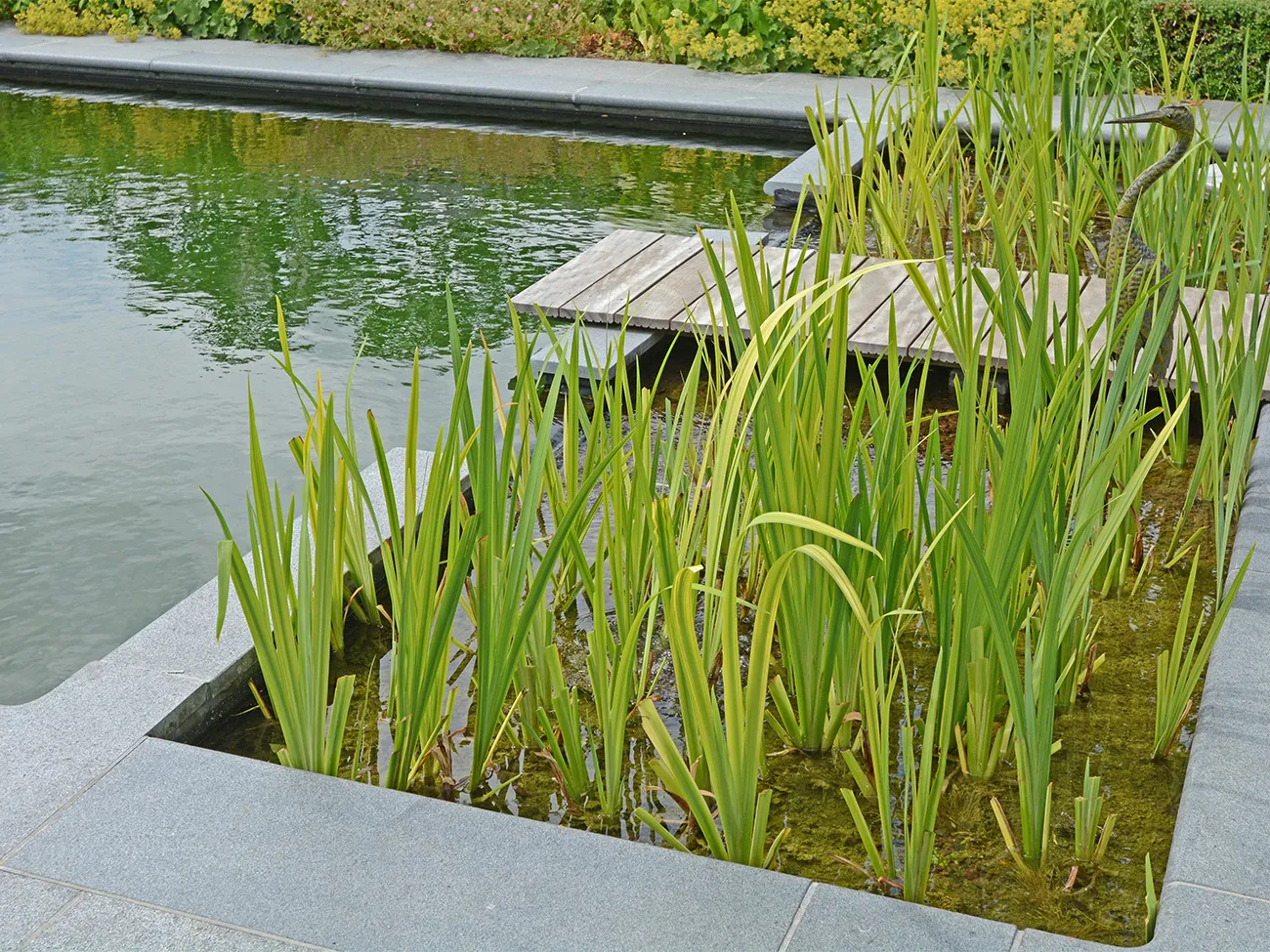
Downflow filtration in a regeneration zone
The oldest system used in natural swimming ponds is the downflow principle. Here, water flows from top to bottom and is purified by plants and a layer of substrate. Ideally, the inlet to the regeneration zone is on the north-east side of the swimming pond.
In this case, the prevailing south-westerly winds help carry dirt particles towards the regeneration bed. All pollutants remain in the system and are treated by nature. This system consumes very little energy, and the regeneration zone creates an interesting biotope for the pond. It is therefore the most environmentally friendly type of swimming pond.
Upflow filtration in a regeneration zone
When greater environmental pollution is expected, for example near large trees, roads or industrial sites, and the aim is to prevent the regeneration zone from becoming saturated, the upflow principle is used. Here, water moves in the opposite direction, from bottom to top, and first passes through a curved screen or mechanical pre-filter. Some of the pollutants are removed from the water, and nature takes care of the rest.
This system still consumes relatively little energy, and the planted zone once again creates an interesting biotope for the pool. As the regeneration zone is protected from contamination, it will last longer.
Multi-chamber filter with regeneration zone
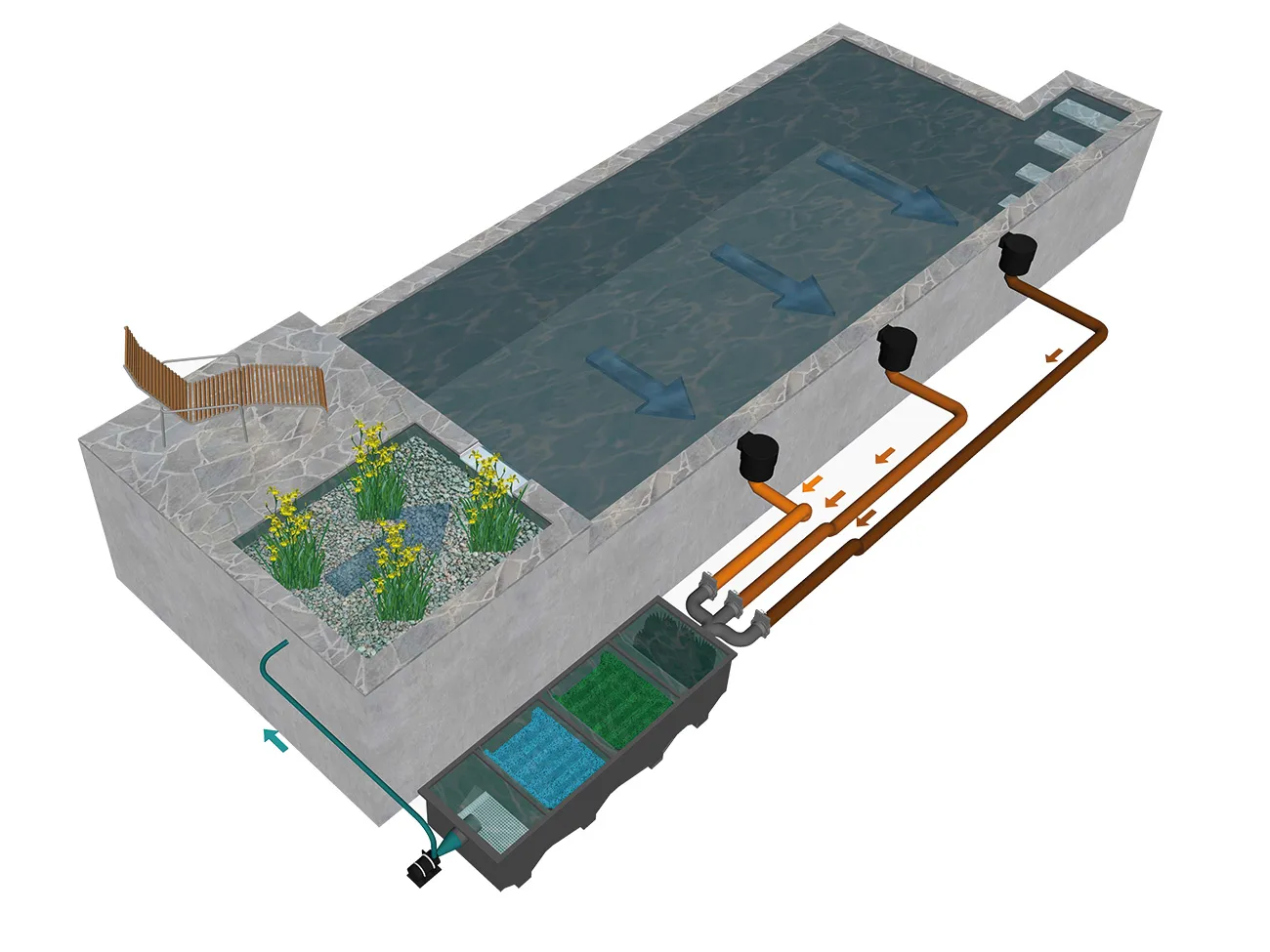
In a system combining a multi-chamber filter with a regeneration zone, water flows horizontally or vertically through the planted filter bed. Water leaves the swimming area via skimmers and then passes through a multi-chamber filter. The successive filter chambers contain different filter media, from coarse to fine. A pump then directs the pre-filtered water through the planted regeneration zone.
This solution also uses little energy, and the plant-rich zone creates an interesting biotope for the pool. Much of the pollution has already been filtered out before the water passes through the regeneration zone.
Biological swimming pool
In biological swimming pools, mechanical and biological processes are accelerated so that filtration remains effective even with smaller water volumes. This is achieved by controlled additions of minerals and bacteria, and can be partially automated. There is no regeneration zone.
For example, combining a drum filter with a moving bed and a UV filter creates an effective mechanical and biological filtration system. Even very small solid dirt particles are immediately captured in the water.
This system is very compact, but is at the higher end of the price range. Monitoring is straightforward with Aquatic Science’s Spintouch water analysis system.
Physico-chemical filtration
In swimming ponds with physico-chemical filtration, filtration is naturally less natural, and the water is disinfected by hydrolysis and UV radiation. There is an important distinction between physico-chemical filtration with and without added salt.
Without added salt
In this system, no salt is deliberately added. Instead, copper ionisation is used in combination with pH control. A plant-rich regeneration zone absorbs residual substances and gives the pool a natural appearance. To limit algae growth, an additional phosphate filter is strongly recommended. In systems that are working properly, concentrations are so low that they pose no health risk to bathers, although frequent measurement of copper levels is recommended.
The equipment for this system is housed in a garden shed or plant room. It is at the higher end of the price range.
With added salt
A swimming pool with physico-chemical treatment and added salt goes a step further. In this case, disinfection is the chosen option. As salt is added to the water, the system uses low-conductivity salt electrolysis to produce chlorine. This type of pool is therefore unsuitable for fish or plants, and cannot incorporate a regeneration zone or plant filter. In short, it is no longer a swimming pond, but a swimming pool. Many “hybrid pools” also fall into this category.
Using salt electrolysis requires careful consideration of the materials used. EPDM or TPO waterproofing membranes may be affected. Stainless steel 316 is preferable to stainless steel 304.
The equipment for this system is installed in a garden shed or plant room.
Biofilm
The presence of biofilm on the walls of swimming ponds cannot be ruled out. In fact, this biofilm is essential to the proper functioning of the natural system.
Heating
In principle, all systems allow for some form of supplementary heating, although overdoing it is not recommended. It is best to limit heat loss as much as possible, for example by using HeatCover. This invisible liquid cover reduces evaporation and heat loss without detracting from the pool’s attractive natural appearance.
Question about this story? Ask your question
Keep following this
Get an email when a new story is published. No account needed.
- ThemeBuilding swimming pools and ponds
- SubjectNews