Agricultural & horticultural machinery
How do you restore a lawn after summer? ELIET explains
Text and images Eliet Europe NV
The past month was all about the FIFA World Cup. Millions of people followed the matches, but professionals in green space management will no doubt also have been looking at the quality of the pitches. Despite high temperatures and intense use, the playing surfaces remained in remarkably good condition. A fine achievement by the groundskeepers.
While most people were focused on what was happening on the pitch, many readers of this magazine will also have paid attention to the quality of the turf on which the spectacle took place. As a professional landscaping contractor, you know how difficult it is to keep a lawn in top condition. All the more impressive, then, that this can be achieved under the extreme conditions to which a World Cup pitch is exposed. The groundskeepers, who often make it possible under considerable time pressure and with many hours of overtime, are rightly held in high regard.
At a World Cup, budgets naturally take a back seat. All eyes are on the pitch, after all. This stands in stark contrast to the day-to-day work of landscaping contractors, who want to create or maintain a perfect lawn for private clients too, but usually have to work within a limited budget.
Private lawns often look less attractive after summer too. The combination of heat, drought, World Cup parties, barbecues and other summer activities takes its toll. For lawn-care specialists, autumn is therefore the ideal time to carry out the right work and get the turf back into top condition. ELIET shows how a well-planned renovation can completely transform a lawn in just a few weeks, at an affordable cost.
Good preparation
Drought is often the main cause of grass dieback. It is therefore essential to first remove dead material from the turf, creating space for healthy grass to grow again.
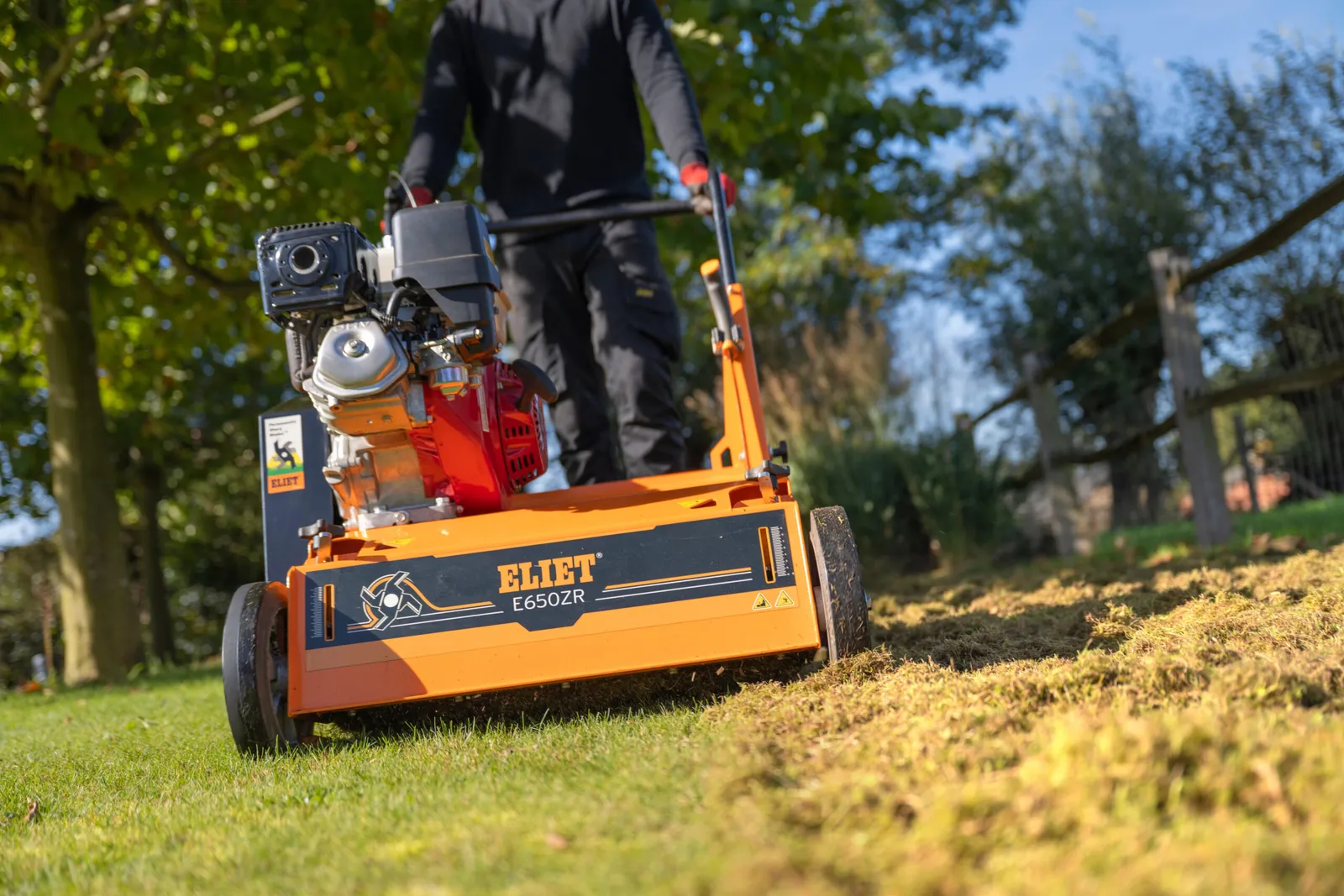
The latest generation of self-propelled E-ZR scarifiers offers a number of important advantages. They are fitted with extra-thin Permanent Pointed™ blades spaced just 15 mm apart, allowing the turf to be thoroughly cleaned in a single pass while causing minimal disturbance to the existing grass.
Unlike the rotor on a conventional scarifier, the rotor carrying these blades turns in an over-the-top direction. This rotation lifts dead grass, moss and thatch completely out of the turf, so the material can be removed efficiently.
The E-ZR scarifiers are also self-propelled and travel on a roller. This means the lawn is firmed up again as it is scarified, leaving it perfectly prepared for the next stage of the renovation.
Set the stage for successful rejuvenation
Once the lawn has been cleared, the next step is to restore the density of the grass. A strong, healthy lawn has dense growth, leaving less room for weeds and other unwanted plants. Sowing new grass seed fills bare patches while giving the turf a thorough rejuvenation.
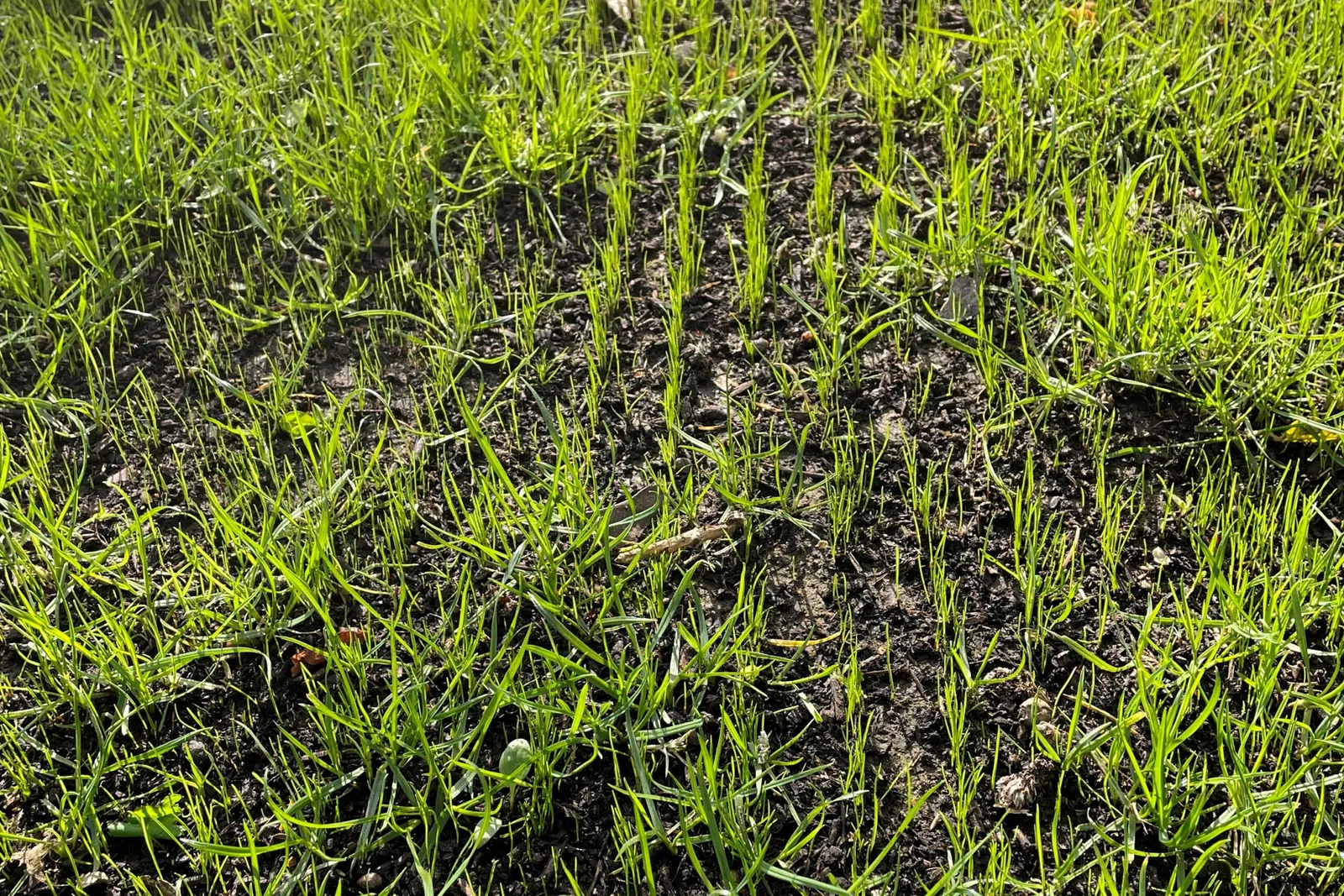
Overseeding can be carried out effectively with the ELIET DZC450 overseeder. The key is to ensure the grass seed actually reaches the soil. To achieve this, the machine cuts grooves 0.8 cm deep. Its patented seed distribution system injects the grass seed into the groove immediately after it is cut. The machine then rolls the seeded groove closed straight away, enclosing the new seed securely. Soil brought to the surface during grooving is spread evenly over the seedbed, forming a protective layer.
The DZC450 seed rows are spaced just 25 mm apart. As a result, once the seed has come through, it creates what is effectively a completely new lawn within the existing one. The clear, continuous seed rows also demonstrate that ELIET’s seeding technology leaves virtually no seed wasted.
The transformation is often visible after about two weeks. Landscaping contractors can therefore expect an enthusiastic call from their clients during this period.
Autumn is the ideal time for overseeding. The soil has warmed sufficiently over the summer, and grass germinates best when the soil temperature is above 12 °C. Grass seed also needs sufficient moisture to start germinating. In autumn, greater differences between daytime and night-time temperatures lead to more dew, while rainfall also becomes more frequent. This keeps moisture levels in the topsoil more consistent.
It is therefore best to plan overseeding when a spell of rain is forecast. The combination of a sufficiently high soil temperature and enough moisture ensures that the grass comes through quickly.
Pay attention to aftercare
Overseeding in autumn offers another important advantage. The young grass has plenty of time to develop a deep root system and a strong leaf canopy. Its first real test comes during the next prolonged dry spell. With a well-developed root system, the young grass is better able to withstand the drying out of the topsoil.
It is important to promote grass growth in a targeted way after overseeding. Fertiliser can be applied, preferably a slow-release organic fertiliser. A heavy application of nitrogen mainly stimulates existing grass growth, which slows the development of young grass. In the worst case, the young grass seedlings may even be damaged.
Finishing the renovated lawn with a layer of topdressing made from a compost mix also offers many benefits. The material’s dark colour raises the soil temperature and stimulates germination. The compost also activates soil life, improves soil structure and promotes root development. Drainage capacity increases too, allowing rainwater to be absorbed more effectively. Organic matter helps retain nutrients and keeps dew and condensation moisture at the soil surface for longer. This is particularly valuable during the early growth stage of grass seedlings.
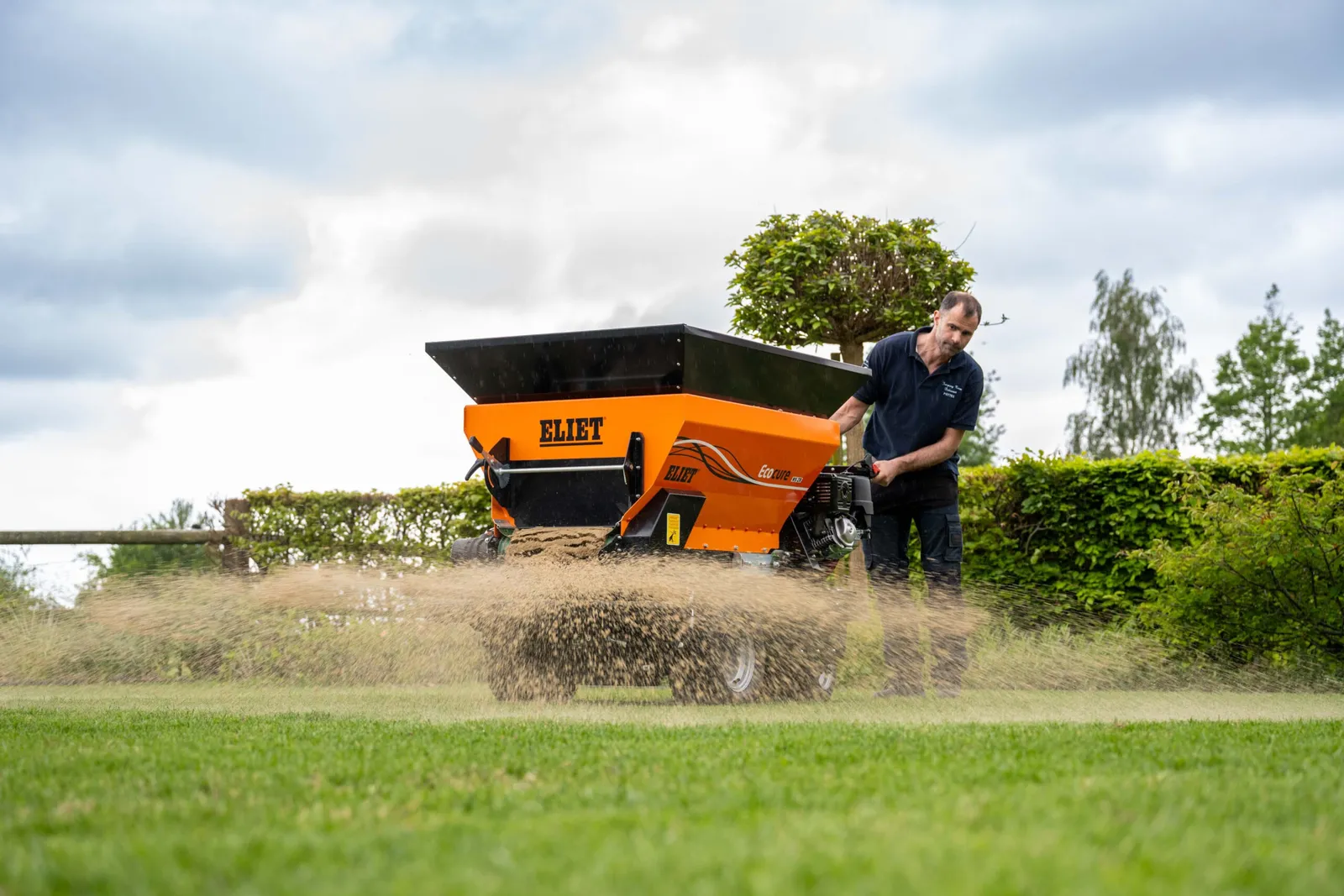
Topdressing is best applied immediately after overseeding. ELIET’s EcoCure ZR WS, a 600-litre wide-spreading topdresser, distributes topdressing quickly, evenly and accurately across the lawn. Its adjustable spreading width of up to 6 metres makes the job particularly efficient. With its wide range of adjustment options, the machine can handle a broad range of topdressing mixes. This fully hydraulic topdresser is also highly manoeuvrable, even on smaller areas.
A beautiful lawn starts in autumn
Renovating a lawn in autumn is not an unnecessary expense, but a worthwhile investment. Taking the right steps after summer gives the lawn every chance to recover fully and start spring in strong condition.
With the right ELIET machines, from the E-ZR scarifier and DZC450 overseeder to the EcoCure ZR WS topdresser, professional landscaping contractors have a complete, carefully planned renovation programme at their disposal. Efficient, affordable and with results that speak for themselves. A beautiful lawn does not start in spring, it is made in autumn.
Question about this story? Ask your question
Keep following this
Get an email when a new story is published. No account needed.
- ThemeHard-wearing turf
- SubjectAgricultural & horticultural machinery