Blue-green oases at height: the future of sustainable urban water management

Green roofs play an important role in urban rainwater management.
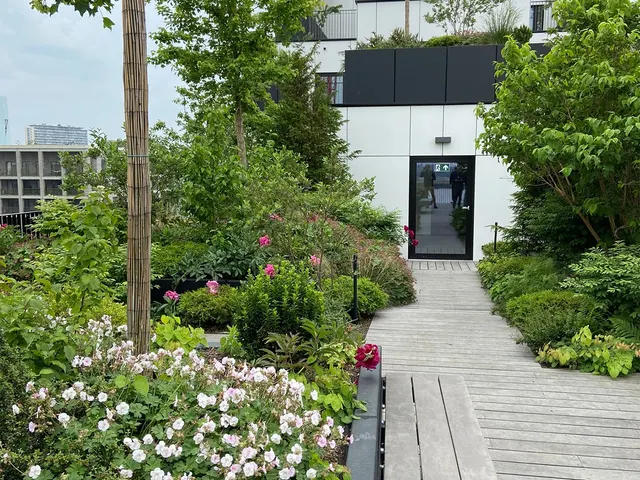
First, less rainwater runs off a green roof. The green roof build-up retains some of the water, which returns naturally to the atmosphere through evapotranspiration, the evaporation of water from the green roof build-up, and through the plants. The amount of rainfall that actually runs off depends on the type and build-up of the green roof. Extensive sedum roofs with a slope of < 15° and a substrate layer of 6 to 10 cm have an average annual runoff reduction of 50%. On intensive green roofs with more than 50 cm of substrate, this figure can rise to 90%.
As well as reducing runoff, green roofs also slow it down, mitigating the impact of heavy downpours and reducing the risk of flooding. During a peak rainfall event of 27 mm over 15 minutes (or 300 l/s/ha), following complete water saturation and 24 hours of drainage, both types of green roof achieve a similar reduction in rainwater runoff. The new rainwater regulations do not distinguish between them. A maximum of 50% of the area of a green roof may be deducted, regardless of whether it is a sedum roof with 8 cm of substrate or an intensive roof garden with a substrate layer of more than 1 metre.
As heavy downpours become more intense and frequent, interest is growing in blue roofs, or retention roofs, which are specifically designed to temporarily store rainwater and release it at a controlled rate. The best-known system consists of a large-capacity storage layer made up of interlocking, load-bearing units. The discharge rate can be controlled. During a peak rainfall event, this means that less than 1% of the rainfall enters the drainage system. More than 99% is stored and released at a greatly reduced rate. This is why it is known as a water-slowing system. Smart retention roofs even regulate discharge according to weather forecasts. An important requirement for these systems is a completely level roof plane, with no falls, to ensure even water distribution, with due attention to waterproofing and roof build-up. It is a common misconception that retention roofs cannot be installed on sloping roofs. Certain water-slowing systems are well suited to them, including meandering drainage boards. These make the water travel further before it reaches the drain.
Blue-green roofs are an innovative combination of green and blue roofs, integrating the benefits of vegetation with water storage and management. To reduce the plants’ irrigation requirements, it is desirable to store some of the water on the roof for reuse. A blue-green roof not only slows water discharge, but also reduces runoff. The retention layer can be seen as combining a rainwater tank, with water reused by the plants, and a storage facility with controlled discharge. Correct sizing to account for both parameters is crucial. Where there is a shortfall, an external rainwater tank and a simple top-up system can provide a solution.
(Blue) green roofs often limit the opportunities to use rainwater for other purposes, meaning that valuable drinking water is still required. However, we advocate greywater recycling as an alternative for household uses. Lightly polluted water, such as wastewater from showers, washbasins and washing machines, is collected, naturally treated and reused for non-potable applications such as toilet flushing. This ensures a continuous water supply, even during prolonged dry periods. It also leaves a greater reserve of rainwater for irrigating gardens and green roofs.
In short, blue-green roofs offer an advanced, sustainable solution to urban water management challenges, while helping to improve air quality, thermal insulation and urban biodiversity.
Simon Mortelmans
Bio-engineer, managing director of B-GT
Question about this story? Ask your question
Keep following this
Get an email when a new story is published. No account needed.
- ThemeHealthy soil and smart water management
- SubjectIn conversation