Agricultural & horticultural machinery
Making green space management easier with electric and (semi-)autonomous machines
Husqvarna’s Living City focuses this time on more urban green space and smarter tools
‘Rethinking urban green space.’ That, in a loose translation, was the theme of Living City 2022, held in London in mid-October. Organiser Husqvarna aims to help green space managers with state-of-the-art maintenance machines that save time and money. They are increasingly electric, and can also operate autonomously or be controlled remotely. The conclusion: green space management is changing, to the considerable benefit of our surroundings, and ultimately of us too.
Nigel Dunnet is a professor at the University of Sheffield. His is no dull job: he loves nature, and is passionate about planting that is just a little wilder (read: more natural) than what we are used to seeing in our cities. As a remarkable achievement, he even transformed the bare lawn around the Tower of London into an attractive sea of flowers and plants (see photo).
Dunnet believes it is precisely this wilder approach that will benefit cities: more colour, more diversity, more insects and, ultimately, happier residents. His advice is not to mow everything down again too soon. That may be bad news for lawnmower suppliers, but it is better for the future of us all.

Buildings packed too closely together for green space
Another issue is the traditional practice of building at high density, leaving hardly any room for green spaces between buildings. The appeal to urban planners is essentially to sit down with landscape architects more often, so that we can move from a dead, paved environment to a living, greener place to live and work. The health and wellbeing of residents are not the only considerations. The need to make our cities more climate-resilient is increasingly coming to the fore, for example by retaining rainwater for longer in green spaces, including on roofs, and increasing CO2 absorption by planting more trees and not felling existing ones too soon.
It is also clear that the COVID-19 pandemic has given policy attention to green space an extra boost. More working from home calls for a relaxing outdoor space where people can enjoy brief social, sporting and recreational activities.

Innovative machines and tools
Husqvarna clearly has a taste for innovation: several smart machines and devices were demonstrated at Living City 2022. They are intended, among other things, for the management and maintenance of large urban parks, sports fields, golf courses and even airports and landscaped solar parks. The Swedish company is taking two approaches.
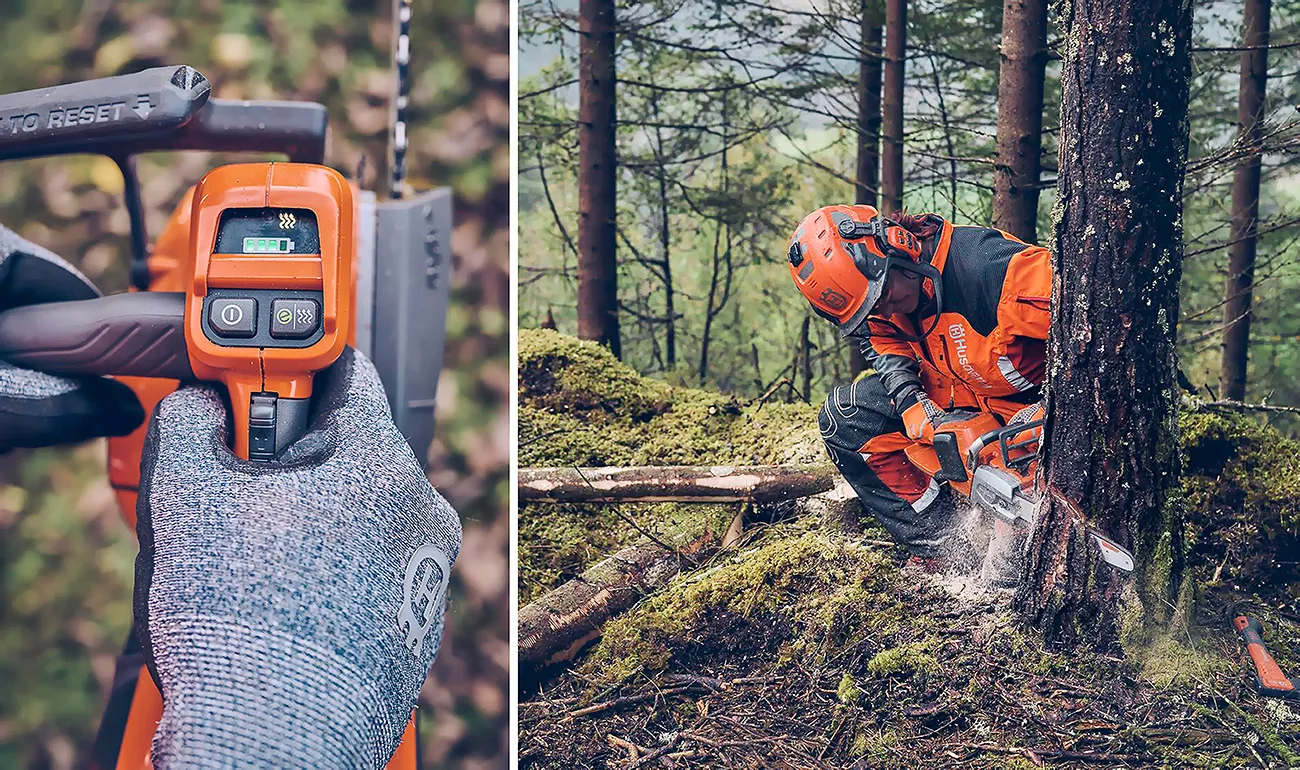
The first is electrification, including of lawnmowers. This is a logical step, following the shift from petrol to battery power for hand-held tools. No fumes, no mess, less physical effort to start, and less danger. Plus, of course, far lower CO2 emissions. Batteries have now proved their performance in terms of power and runtime, and more and more machines and tools can be electrified. The new Husqvarna BLi-X 36V batteries, for example, come in three different capacities and feature ActiveCool. They are part of the 525i range of electric grass trimmers and brushcutters, due to come to market in 2023. According to Husqvarna, they perform just as well as the 25cc petrol models.
The second approach is even more interesting: making lawnmowers more autonomous. Husqvarna now describes itself as a ‘world leader’ in robotic mowers, and plans to build on that claim with new and improved machines in the coming period.
Working safely on steep slopes
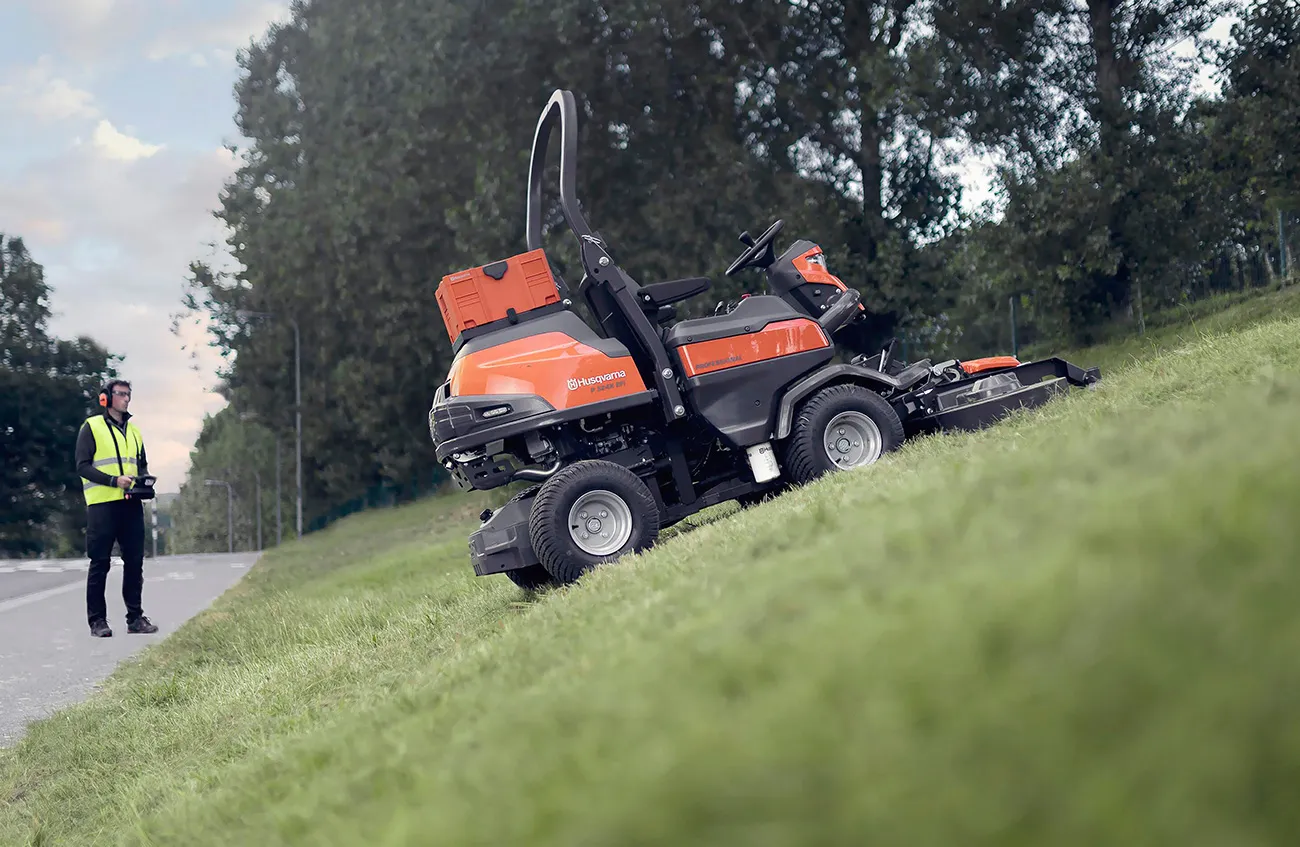
Operating a large mower on a slope after a rain shower poses risks for the driver. So it makes sense to keep them at a safe distance and let the machine do the mowing on the steep slope, up to 60 degrees. The P 524XR EFI commercial front mower has therefore been fitted with a remote control in the form of a belt-worn transmitter. Switching between the onboard controls and remote control is quick and seamless. The front mower can also reach areas that are often missed, such as beneath overhanging branches. The new facelifted X model of the P 524 mower, which still has a petrol engine, also comes with a new 137 cm-wide cutting deck, a digital user interface and built-in Husqvarna Fleet Services connectivity.
Mowing solar parks and airports
Autonomous mowing is more cost-effective, but has always been difficult to implement on large sites such as airports, due to safety concerns, and solar parks, with their many obstacles and GPS signal obstructions.
The Autonomous Operation System for Professionals is designed specifically for these challenging situations. It uses a highly accurate satellite navigation system that provides improved real-time positioning accuracy. Location accuracy is 2-3 centimetres, and as an additional safety measure, an operator can manoeuvre and control the system remotely. The machines are fully electric, running on solar power in the solar park. Husqvarna aims to demonstrate the potential of this technology with a pilot project at a Swedish airport.
CEORA tackles the diversity of golf courses
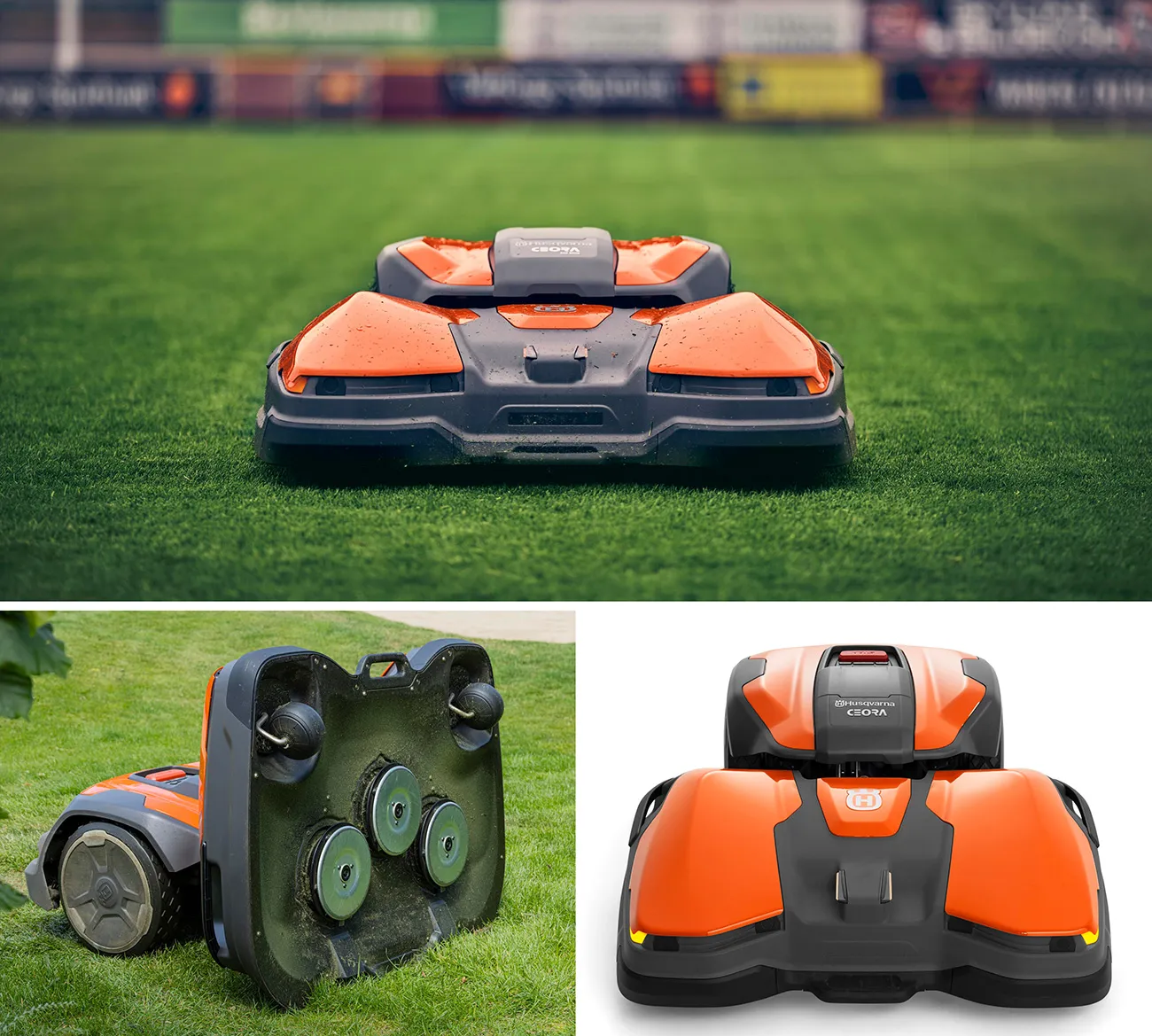
Husqvarna is introducing the professional CEORA robotic mower, with its new, lower 43L cutting deck, specifically for large and varied grass areas. With a capacity of 20,000-25,000 square metres per day, CEORA can mow up to three standard-sized fairways a day. Its electric cutting height adjustment allows the same robotic mower to cut fairways, semi-rough, rough and other sports surfaces at heights of 10 to 60 mm.
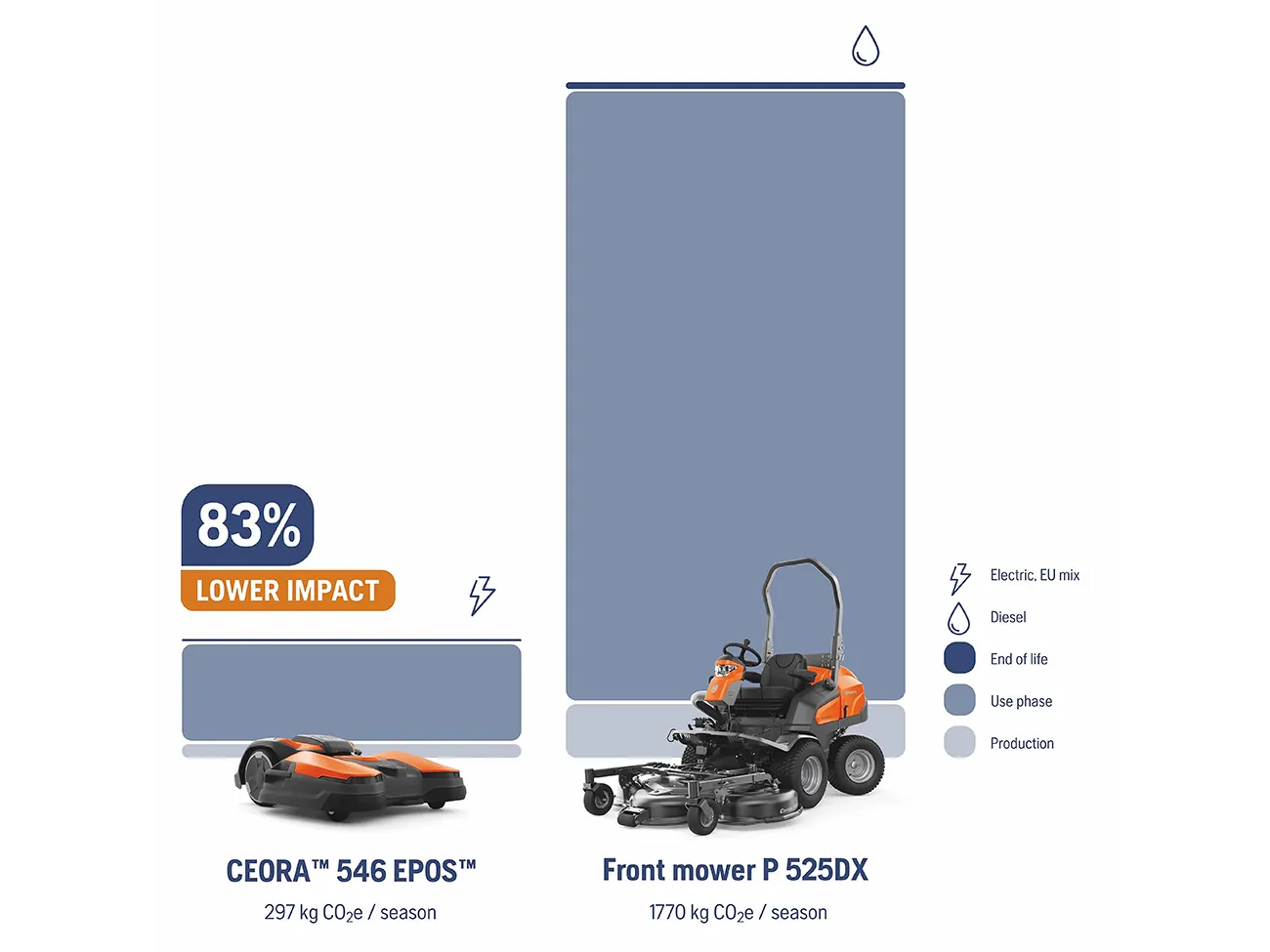
The autonomous, electric mower reduces maintenance costs and can cut CO2 emissions over the machine’s lifetime by as much as 83% compared with a diesel-powered Husqvarna P 525DX ride-on mower (see illustration).
Another improvement is planned for 2023: an upgrade to the Automower 550 EPOS, the first robotic mower to use ‘virtual boundary EPOS technology’. It no longer needs a physical boundary wire. Instead, a working area is assigned digitally, after which the mower can double its mowing capacity to 10,000 square metres per day by mowing systematically on its own. EPOS technology is a highly accurate satellite navigation system, delivering accuracy of 2-3 centimetres and enabling multiple mowing patterns.
Question about this story? Ask your question
Keep following this
Get an email when a new story is published. No account needed.
- ThemeGreen space for everyone
- SubjectAgricultural & horticultural machinery