









Brussel Mobiliteit invests in a smart irrigation system for trees
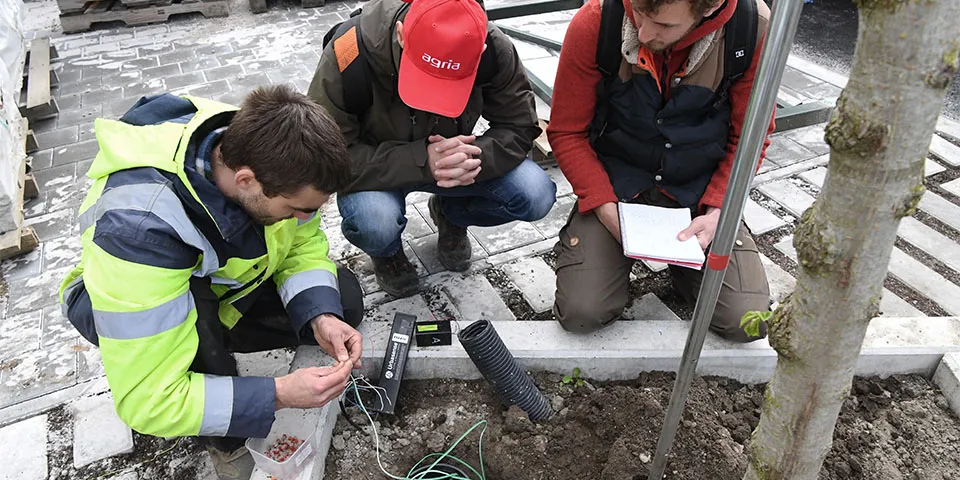
Mobiliteit Brussel is responsible for mobility strategies and infrastructure projects within the Brussels-Capital Region. Public green spaces also fall within its remit. In this area, the organisation faced a number of challenges, as have many other European cities. Many trees in the city are suffering from climate change, water shortages, hard surfaces, and emerging diseases and harmful insects. Mobiliteit Brussel recently introduced a new automated irrigation system to supply water to the trees.
A remedy for looming water shortages and disease
Important decisions
Brussels has more than 32,000 trees in public spaces and along regional roads. Monitoring and maintaining these trees continually involves making important decisions. Which trees need to be felled and replaced, and which can still be saved? Should these weaker trees be felled and replaced individually as needed, or should all the trees along the same avenue be dealt with at the same time?
Monoculture or diversification?
To prevent diseases from spreading, a number of European cities have already opted to plant different tree species along the same street. Most diseases primarily affect a particular tree species. Diversifying the species planted may well become the norm in the future.
At present, for example, chestnut trees are facing a serious problem. ‘Chestnut blight’ is a highly contagious and fatal disease that kills trees irreversibly. However, one of the basic requirements for healthy urban trees is an adequate water supply, neither too much nor too little. With this in mind, an automated irrigation system has been developed.
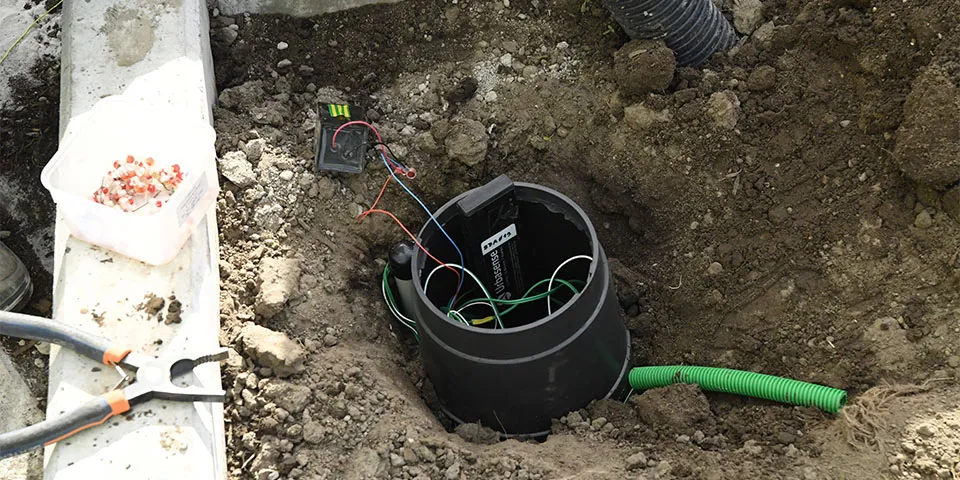
Installing the tensiometric probes. (Copyright GOB)
Tensiometric probes
Hundreds of trees are now equipped with tensiometric probes that continuously monitor moisture levels at their planting sites. The probes measure the trees’ water requirements, taking into account their physiology and the climate, as well as the amount of water available in the soil. The measurement data are sent to an application that enables the administration to monitor the plants regularly and sends alerts that are used to schedule individual watering sessions. It was also decided that every newly planted tree would be equipped with this system.
Saving water
Under normal conditions, each tree needs around 120 litres of water per watering session. The probes can save considerable quantities of water at a time of water scarcity. Trees should receive water above all when they really need it. A tree that gets too much water will suffocate and stop growing roots. When it comes to watering, more is certainly not always better. The probes ensure that each tree gets the amount of water it needs, without wasting water unnecessarily.
In 2020, more than 560 trees were already benefiting from this technology, and further projects are currently in development. Recent or soon-to-be-completed examples can be found on Steenweg op Bergen, at Pol Burysquare, Docks-ovonde, Hallepoort, Olympische Dreef, Regentlaan and Henri Simonetlaan.
Efficient maintenance
Using a cartographic management system with geolocation, Brussel Mobiliteit can monitor the characteristics and condition of every tree along regional roads and in public spaces. This significantly improves the efficiency of monitoring and maintenance, and enables highly targeted action. Further changes to the climate in our region will require vigilance, and these probes make an important contribution. Their real-time information supports sound decision-making, enables a rapid response and therefore plays a key role in preserving Brussels’s tree population, and potentially that of other cities in the country too.
Question about this story? Ask your question
Keep following this
Get an email when a new story is published. No account needed.
- SubjectGeneral







