









Climate change and a loss of biodiversity threaten our tree population
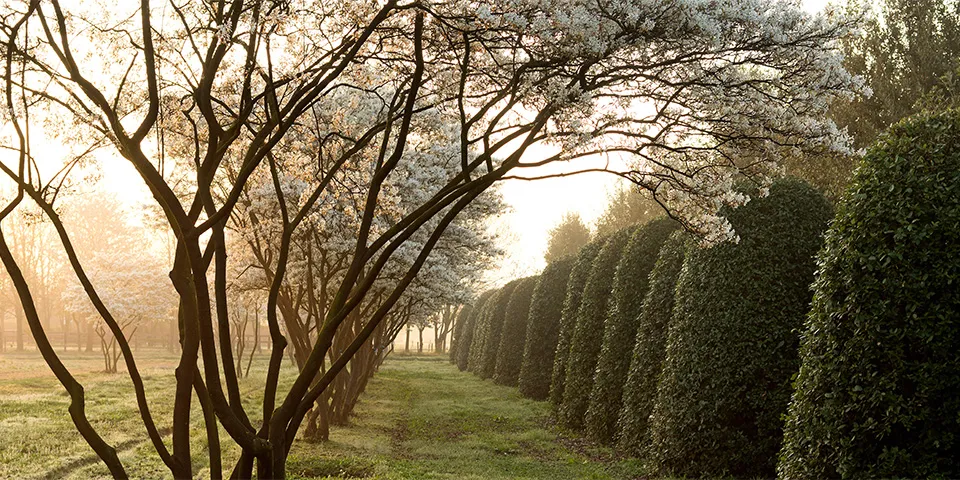
Ebben B.V. in Cuijk has specialised in growing exceptional trees and shrubs since 1862. Its vision for the experience of green spaces is to give more identity to the places where we live, work and spend our time. The aim is to create a balance between the rural and urban environment. Calling for greater biodiversity, the company has also been a pioneer in the fight against the threats to our tree population: a loss of biodiversity, which can cause widespread mortality through various forms of damage, and climate change, which poses new challenges.
A degree warmer
We can already see that certain tree species are struggling to adapt to climate change. However, there is no need to panic just yet. Importing large numbers of exotic trees from southern regions is certainly not the answer. They also need plenty of time to adapt to our conditions, and their introduction increases the risk of introducing exotic parasites.
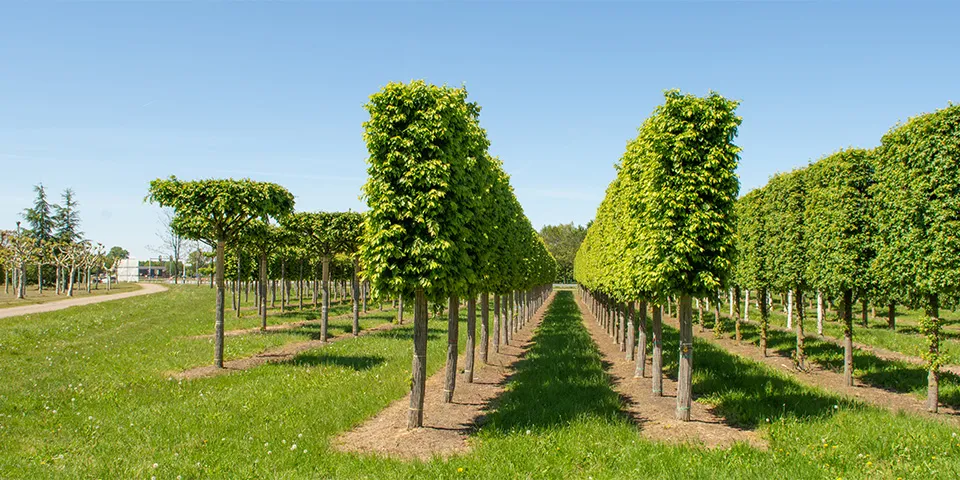
A sculptural effect with pleached trees.
The only right response is to increase local biodiversity. Planting a diverse range of trees, with birds, insects and mammals in mind, and using cultivars and varieties improves the chances of our tree population surviving in these times of climate change. A diverse planting scheme means there will always be trees better able to adapt and thrive.
Troublesome diseases and damage
The oak bark beetle and the processionary moth caterpillar are spreading rapidly and causing significant damage. Diseases such as ash dieback and bleeding canker of horse chestnut are also decimating European cities. A narrow choice of tree species and a lack of diversity in planting mean that diseases and other forms of damage can have disastrous consequences in a short time, leading to irreparable harm. Imagine all the lime trees in Berlin suddenly disappearing because of a single disease or pest. Or the branches of all the plane trees on the Champs-Élysées breaking off because of Massaria disease… Since different species are susceptible to different threats, diversity is the answer here too. After elms were cleared during the major Dutch elm disease outbreaks at the end of the last century, plane trees were planted almost everywhere for years. They are strong and suffer from few diseases. Quite apart from making every city look the same, this ‘plane-tree monoculture’ is simply a recipe for trouble: it is only a matter of time before a disease comes along that plane trees cannot survive.
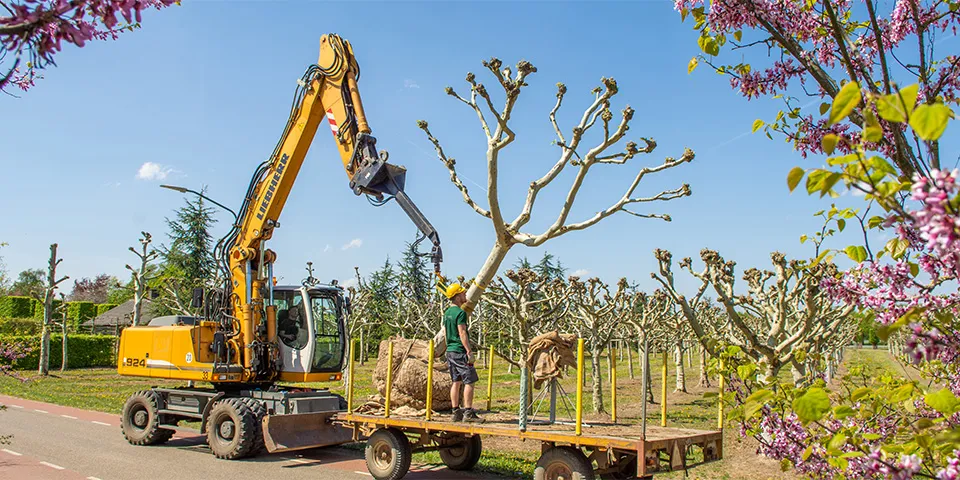
Careful transport, loading and unloading of large trees.
Misguided traditions
Those who argue for planting just one or a few tree species often fall back on misguided traditions. Planting the same trees, they say, creates impressive avenues. Maintaining the same trees is also supposed to be easier. And perhaps the most misguided belief of all: a uniform streetscape with identical trees looks much tidier. Historically, avenues were by no means always planted uniformly. Recent research published by Vlaams Erfgoed shows that avenues were often made up of several tree species. Replacing trees that had died also resulted in trees of different ages. The combination of evergreen and deciduous trees was also often used as a metaphor for eternal life and transience. Applying principles from the English landscape style, such as alternating light and dark areas or framing views, dispels these misconceptions.
More room to play
Diversity in species, varieties and cultivars gives landscape designers a much broader palette for making public spaces more engaging and distinctive. The result is an environment that people find much more pleasant. Variations in colour, form and texture offer endless possibilities, while the influence of the seasons and extending flowering periods give designers plenty of additional scope. Where the design allows more room, it is also possible to opt for less formal planting or to vary the shape of the trees or how they are grouped. In avenues, for example, instead of planting trees in straight lines, designers can choose groups of different species or stagger the trees.
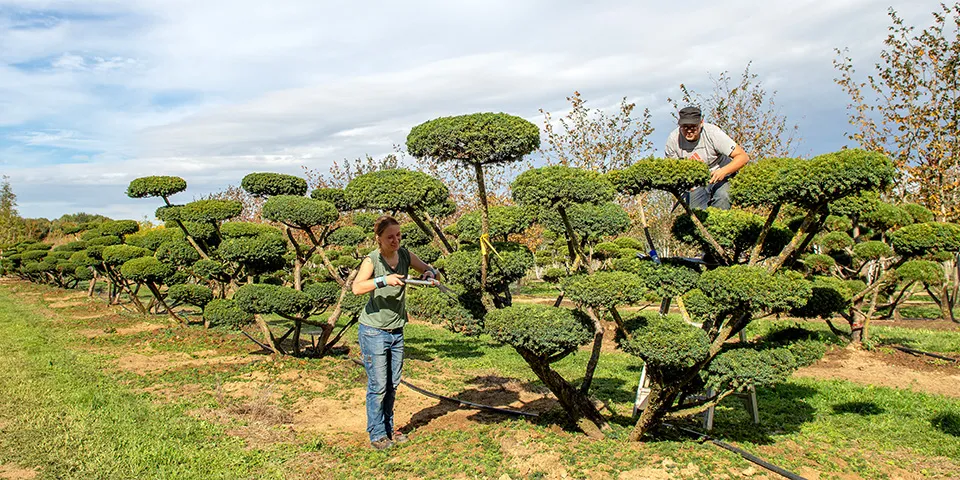
Pruned into shape for a less formal planting scheme.
What does ‘tidy’ mean?
A street lined with the same trees looks cohesive. But what is the experience of that uniform scene, with the same autumn colour and the same blossom every year? Is it tidy or simply dull? To the untrained eye, a row of trees with more or less the same habit, crown size, shape and density soon looks uniform. They do not even need to be the same species. By choosing different tree species that look more or less alike, designers can create surprises with autumn colour, blossom or leaf texture, giving the street an extra dimension as the seasons change.
The right underplanting
Biodiversity is receiving increasing attention in the design of public spaces. Measures are increasingly being taken, including nectar plants for bees and butterflies and host plants for beneficial insects, small mammals and birds. Yet the solution is invariably found in diverse, flowering underplanting. The trees, which live much longer than perennials, are still lined up neatly: one species, preferably pruned into the same tidy shape. The expertise of Boomkwekerij Ebben B.V. is particularly valuable in this context.
Question about this story? Ask your question
Keep following this
Get an email when a new story is published. No account needed.
- SubjectGeneral







