









Discover the benefits, beauty and pleasure of garden water features
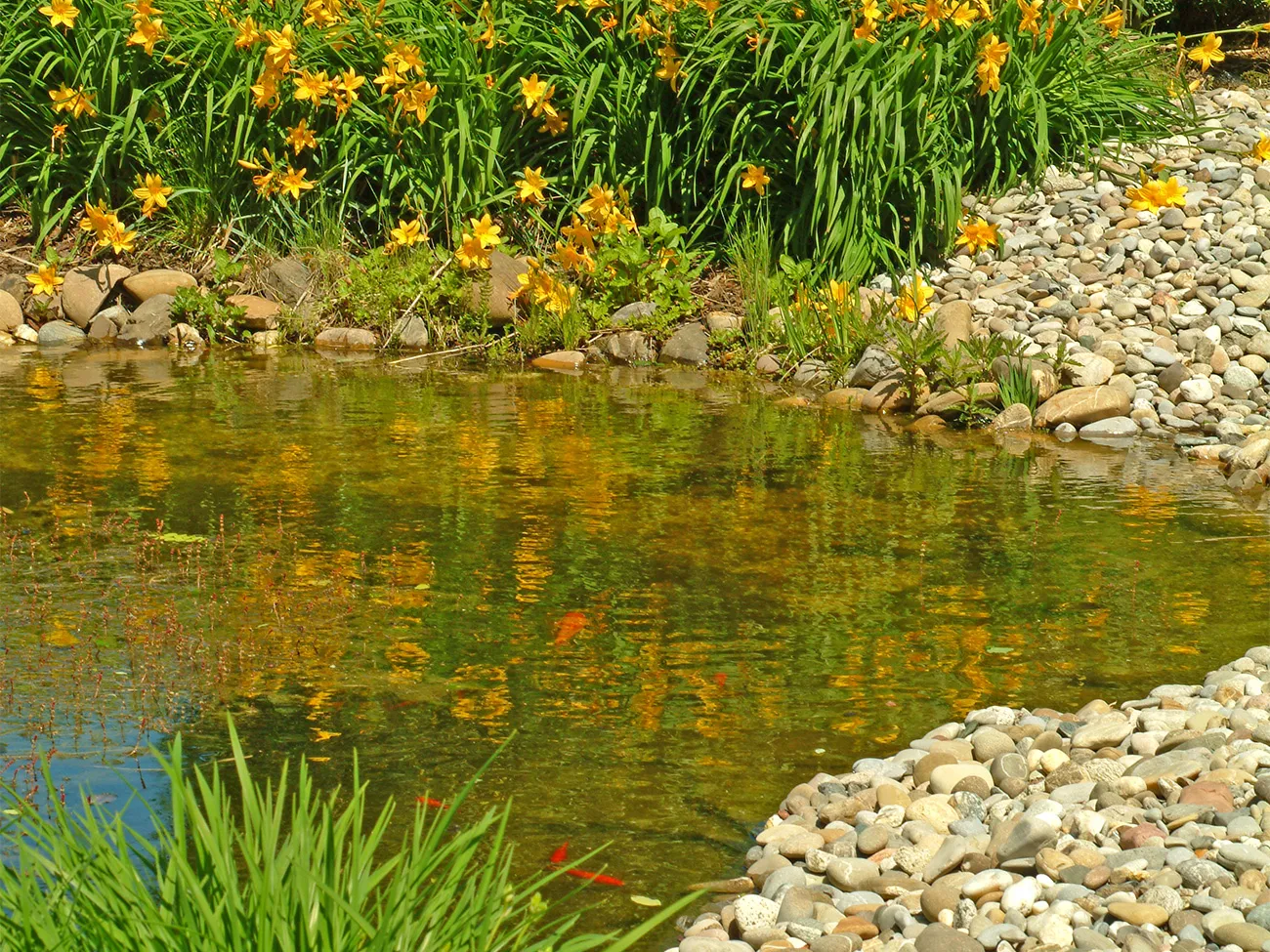
A major player in ponds and water storage, Distri Pond is adapting to changing market conditions. For the past fifteen years, the company has ridden the wave of swimming ponds, with straightforward, transparent concepts based on proven principles of waterproofing and water treatment.
Lockdowns, periods of drought, energy shortages and other threats… have changed, and continue to change, how we view gardens and water.
More nature in the garden is welcome (and necessary)
Recent surveys on gardens all point to the same conclusion: most garden owners want more greenery and biodiversity in their own gardens. This is partly due to the boredom people experienced during lockdowns, and partly to a growing awareness of the role gardens can play as habitats. A stark, ‘empty’ garden with a large patio and flat lawn is now viewed negatively by most people. It quickly loses its appeal and, ecologically, is often little more than a ‘semi-desert’.
That is now changing. Undulating shapes and space for flowering plants are increasingly sought after, even in the tiniest gardens. This is good for butterflies and birds, and much better for hedgehogs and other small creatures.
Garden ponds and the garden climate
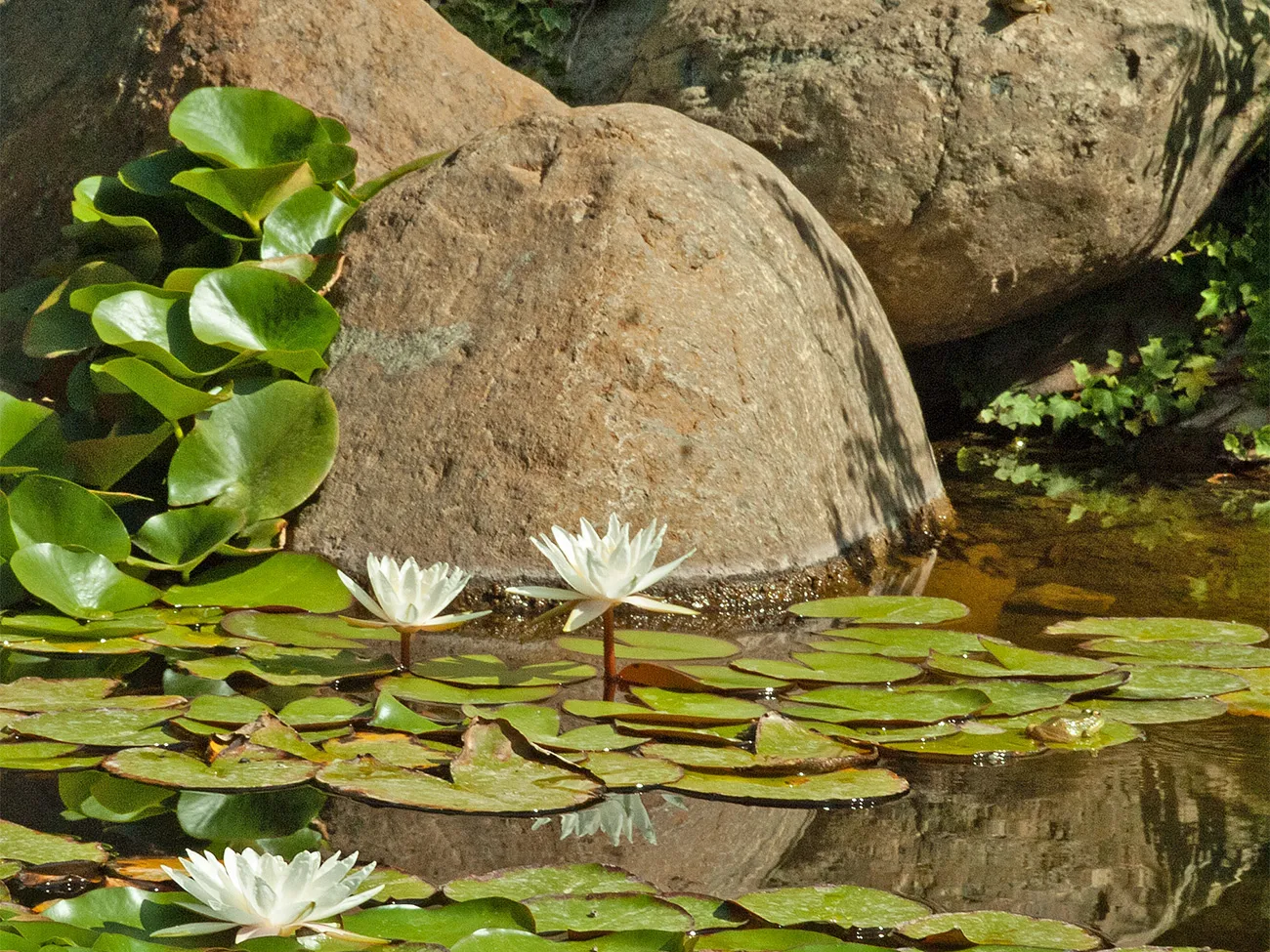
Along with trees, ponds help moderate the local climate. They provide a cooling effect on otherwise excessively hot summer days, acting as natural air conditioning for the garden. This is not just a subjective impression: it can also be measured objectively. The difference can be several degrees Celsius on hot days. Above a water feature, it can be up to 6° cooler. Ideally, wind can blow across or along the water before reaching the seating area. Combined with a tree that draws air over, through or along a water feature, this brings in cooled air. A fountain, back in fashion after a period away, provides extra cooling by creating water droplets.
Garden ponds and water loss
But pond water evaporates, and water is becoming scarcer and more expensive. This raises questions about the impact of ponds. Are ponds a waste of water? Not necessarily. No two ponds are the same. A sunlit water surface, with no plants and exposed to dry winds, loses a fair amount of water. But evaporation can be significantly reduced by covering the surface with floating plants. This is what usually happens in nature. Nature seeks to cover the ground, and the water too.
As water levels fall, we often see natural ponds completely covered with duckweed. Evaporation is almost eliminated, while the life beneath the surface remains protected from drying out.
Floating plants are less practical in a swimming pond. For heated swimming ponds (from 24°C), a liquid pool cover is an elegant solution. The Belgian-developed product HeatCover reduces evaporation by 50%.
Ponds do not always need to be full
Much depends on the design, edging and planting. Water features intended for amphibians and other native aquatic life can certainly cope with fluctuating water levels. This is often the case in nature too. Many aquatic plants are adapted to this and can grow in both (reasonably) deep water and drier conditions.
Our own experience shows that ponds with waterproof liners and sufficient depth do not dry out completely, even if they are never topped up.
As an experiment, I deliberately left some of my ponds untopped for several years. Their depth (0,8m and 1,0 metre) allowed them to retain enough water to see aquatic life through the driest periods. They came through the dry summers of 2019 and 2020 without any problems. In the wet year of 2021, they overflowed. During the drought of 2022, water levels fell particularly low again, but there was still enough water for the pond life. These ponds are somewhat sheltered but in full sun, and are densely planted. The only water they receive comes from the clouds above. The maximum fluctuation in water level is 60 cm.
If, for example, we can connect the downpipe from a garden shed or garage to the pond, it will of course refill more quickly and the water level will never fall so low.
Then we create a wadi
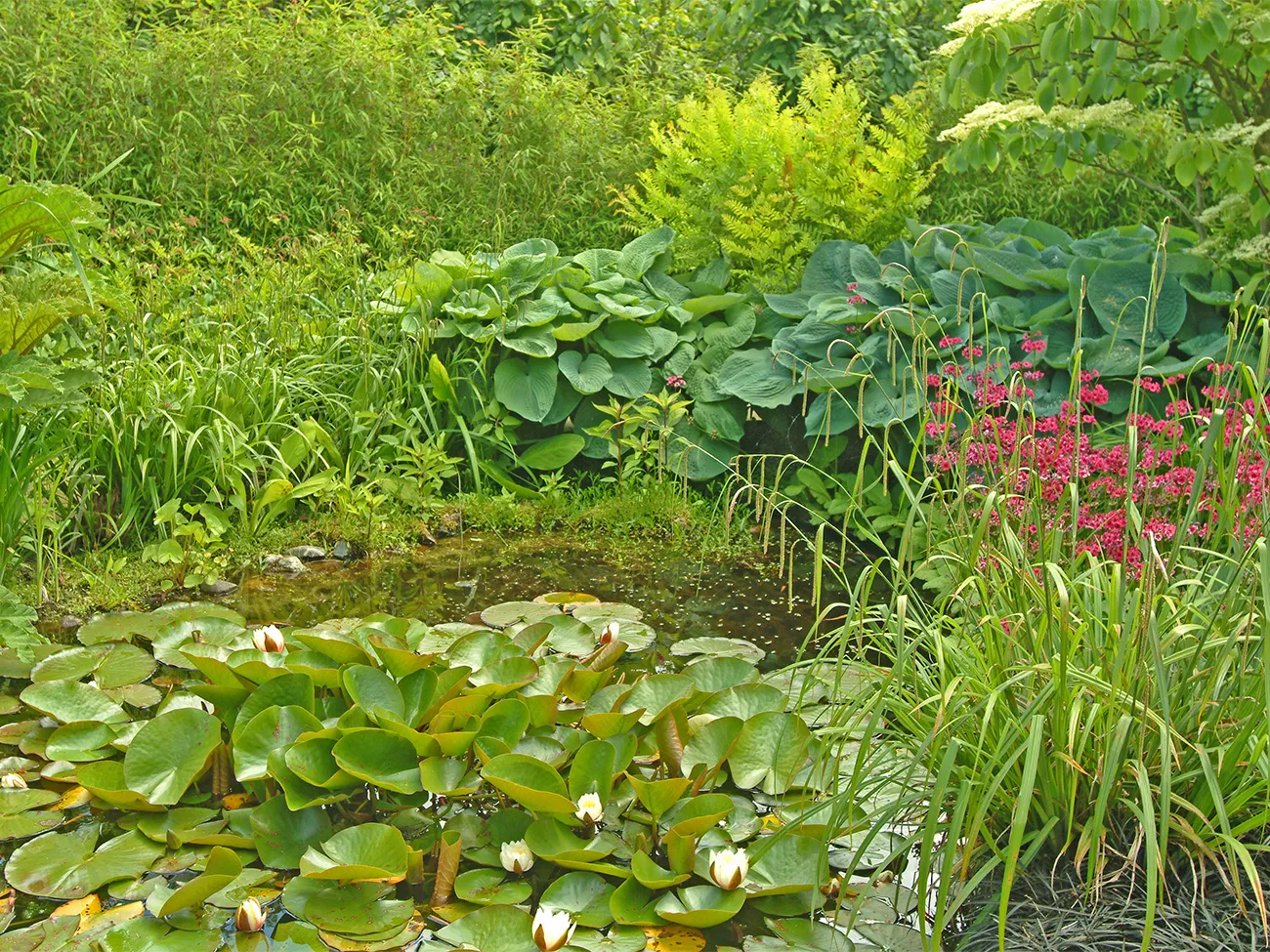
Wadi is an Arabic word with several meanings, ranging from valley and usually dry desert riverbed to a pond with a fluctuating water level. In Dutch, it is also an acronym for Water Afvoer Drainage Infiltratie (water drainage and infiltration). In the Netherlands and Belgium, a wadi generally refers to a stormwater retention and infiltration feature. In a ‘modern wadi’, streets and roofs are disconnected from the sewer system. Rainwater falling on these paved surfaces is channelled through storm drains to a wadi, where it can infiltrate the soil or be discharged slowly into surface water. This prevents clean rainwater from being sent to a wastewater treatment plant, while also genuinely replenishing groundwater.
The ‘pond section’ of the wadi provides extra capacity and helps clean the water locally through the action of micro-organisms and plants.
For new builds or major renovations, it is best not to let any rainwater go to waste. The roof covering is made from environmentally friendly, inert EPDM, while the underground rainwater tank is large and not buried too deep. Overflow from the tank runs into a pond, which in turn overflows into a soakaway.
In existing properties, an above-ground water butt or another form of water storage can be installed. This overflows into a pond, which in turn overflows into an infiltration area.
The infiltration area/soakaway is best located some distance from the buildings, on the property itself. If space is limited, the area beneath and/or around the pond can also be used for infiltration. In that case, it is important to prevent the liner from being pushed upwards by weighting it down across the entire surface with rounded stones or gravel.
Where possible, we make the pond deep enough, at least 80 cm, preferably 100 cm. This makes it more stable and safer for aquatic life. It is best to include at least one gently sloping side. Rounded stones provide a transition from water to land, so the liner is hardly visible, if at all, even when the water level is low. The right choice of plants will also keep the whole feature attractive during drier periods.
This helps tip the balance towards collecting and retaining more water, and wasting less.
More attention to small ponds
There will very likely be renewed interest in small water features in the coming years. A crisis means spending more time at home, and therefore paying more attention to our own gardens. People are increasingly aware that small ponds are ecologically valuable and act as stepping stones for threatened aquatic life, linking natural areas. They also bring even the smallest gardens to life. Building a small pond is not difficult and does not have to be expensive.
A small garden pond can be made ‘climate-resilient’ by following a few simple basic principles. Shelter it slightly from the wind, although most private gardens will offer some protection. Excavate it in tiers to create different depths, for example, a 20 cm-deep level, a step down to 50 cm, and an area 100 cm deep.
A tiered pond like this has many advantages: it quickly reaches a good depth, is easy to access, and allows layers of sediment to spread evenly across the whole surface. The deepest section has a smaller surface area, helping to buffer extremes of cold and drought.
Rounded stones, rocks, tree stumps and plants conceal the pond edges. A gently sloping beach is another option. Small creatures can easily get in and out of the water. Some shade around midday is welcome. This can be provided, for example, by a sleep tree, which unfurls its leaves in the sun. In rainy weather, the pond receives some extra free water from the roof of the garden shed or carport. A small or medium-sized water lily helps prevent water evaporation in summer, while leaving the water surface visible in winter.
Distri Pond leads the way
At the Green trade fair, Distri Pond will be showcasing, among other things, a retail display of pond products for the construction and maintenance of mainly small ponds. It is a range of products that sells itself, presented in a compact and attractive display. To save shop space, we offer liner in small rolls and pre-packed liner, known as ‘prepacks’.
Naturally, water storage will also be in focus, including above-ground storage, which is ideal for rainwater as well as other applications.
DISTRI POND: Stand 1350
www.distripond.com
Question about this story? Ask your question
Keep following this
Get an email when a new story is published. No account needed.
- ThemeWater and hard landscaping in the garden
- SubjectGeneral







