GreenPro Vlaanderen is part of Louwers Mediagroep: 45+ trade platforms in the Netherlands, Flanders and Wallonia. Trade magazines, websites, newsletters, video and podcasts, since 1987.
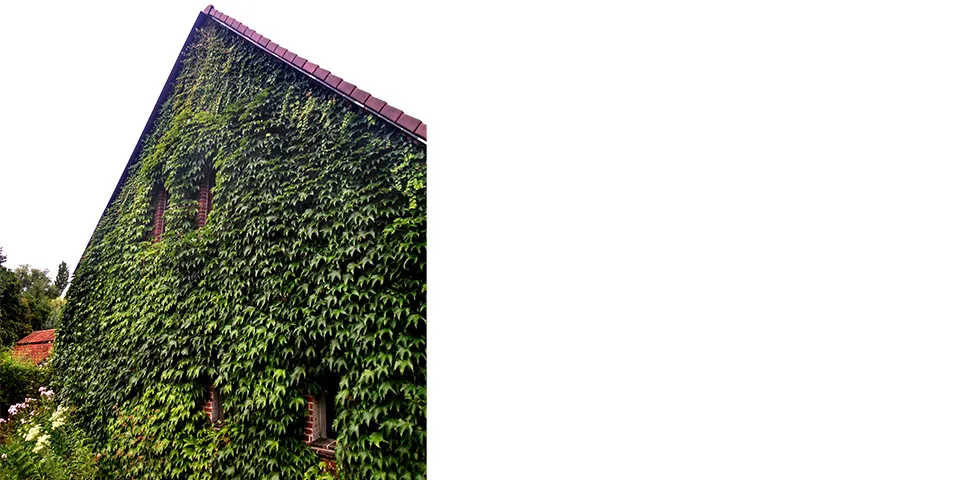
Ground-based green façades and vertical gardens are in. They add that extra touch of charm to country homes. But they also have a lot to offer in urban settings. Green façades have a positive effect on indoor climate, provide a valuable habitat for beneficial animals and insects, protect walls and help purify polluted city air.
Ivy and Virginia creeper are often used on individual homes. But what if your green façade threatens to grow over your head, literally and figuratively? GGGreen has patented a unique solution, Klimopstop, which keeps growth in check simply, without you having to reach for the pruning shears all the time.
The need to control growth
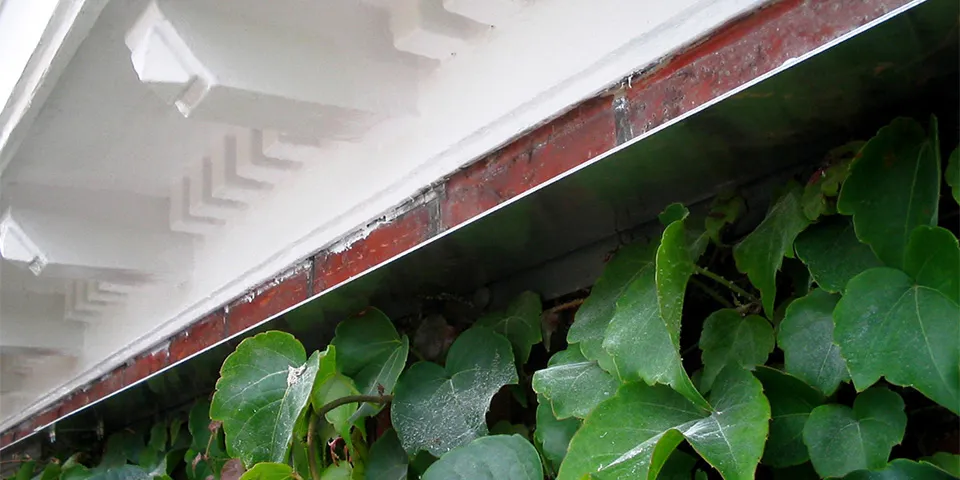
Ground-based, self-clinging climbers such as ivy and Virginia creeper are particularly attractive and add plenty of character, but without growth control they can sometimes do more harm than good over time. Until now, regular manual trimming was a necessary and labour-intensive evil. Ivy is an easy-care plant that makes few demands, but one drawback is that it grows quickly. Without suitable maintenance or adequate containment, it soon grows beyond the wall’s boundaries and gets under gutters, downpipes or roof tiles, where it can cause considerable damage over time. For anyone who would rather avoid manual control, the Klimopstop system offers an automatic, attractive and highly effective solution that needs no attention.
De filtereenheid van het Vitii-Systeem.
How Klimopstop works
The Klimopstop growth limiter is ingenious in its simplicity. The system consists of aluminium profiles that project 10 or 17 cm and are fixed to the wall. In this way, they contain the wall both at the top and along the sides, forming a frame that keeps the vegetation within bounds. The 10 cm depth is used for three-lobed Virginia creeper. Ivy and five-leaved Virginia creeper require a depth of 17 cm. The profiles are energised using an electric fence energiser, scorching any young shoots that grow against them. The current passing through the plants is very low, with a frequency of 1.2 seconds. On contact, you feel only a very slight shock. The aluminium profiles are insulated from the wall using a rubber strip. Klimopstop is so efficient that the power only needs to be switched on for a few hours a day, which can easily be programmed using a timer. This keeps electricity costs to just a few euros a year. The system obtained the European CE mark following safety and interference testing with other devices at Laboratorium De Nayer. KULeuven’s Department of Electrical Engineering tested Klimopstop over four weeks and found it highly effective.
Internationally patented
Klimopstop’s inventor, Peter Boogaerts, is also managing director of GGGreen (GGGevelgroen bvba), which manufactures and markets the system. In 2018, he obtained an international patent for his invention, valid in Belgium, the Netherlands, France, Germany, the United Kingdom and the USA. This patent provides irrefutable proof of the system’s uniqueness.
Research and development
Peter Boogaerts did not rush into developing Klimopstop. A great deal of research and development went into it. The basic version of the growth limiter has been extensively tested since 2014, with further research carried out in collaboration with universities (KULeuven, UAntwerpen and UHasselt) and research institutes (WTCB, Centexbel and PCS). The shape of the limiter and the choice of materials were refined to make installation easier. The system’s effectiveness and expected lifespan were also optimised. Ivy clings well to felted textiles. As an evergreen plant, it offers the potential to create an ivy wall as an innovative façade. In 2018, Peter Boogaerts commissioned the Institute for Materials Research (UHasselt / IMEC) to carry out an extensive chemical analysis of ivy. The plant contains highly valuable raw materials such as phenols and terpenes. There are already practical applications, including as a detergent.
Sustainability
Klimopstop is a system that fits perfectly with today’s focus on sustainability. It is made from aluminium, which is 100% recyclable, and the rubber strips are made from recycled lorry tyres. It also makes a significant contribution to our living environment. In the past, when someone no longer wanted to maintain their façade planting, the plants were simply removed, but traces of their attachment remained visible. With Klimopstop, green façades can be kept with little or no maintenance. Green façades offer undeniable benefits in many respects. They provide insulation, keeping interiors cooler in summer and warmer in winter. When they grow against a wall with the help of a climbing support, they create a cavity that ventilates the walls and keeps them dry. In urban settings, they help keep the air cleaner, including by capturing fine particulate matter. And let’s face it, what could be better than a little extra greenery among all the concrete we live in? Green façades also provide an ideal habitat for increasingly rare bird species and beneficial insects. Klimopstop also contributes to a more sustainable society in another way. The system is manufactured at the WAAK maatwerkbedrijf in Kuurne, which offers people facing barriers to the regular labour market opportunities to develop their potential, giving work to people who might otherwise struggle to find employment.
Installation
Klimopstop is relatively easy to install, but for the best results it is advisable to have it fitted by a professional in the construction or landscaping sector. The aluminium profiles are supplied with the insulating rubber strip, the necessary nail plugs and the sealant. It is also a useful product for green professionals to recommend to clients. Many homeowners are unaware that this kind of solution is available, making it a great way for landscapers to demonstrate their credibility and expertise.
Consultancy and knowledge transfer
GGGreen helps you find the most suitable plants for each specific situation. Although the climbers available in our region are limited to just around twenty genera, information about them is highly fragmented. Prof. Martin Hermy of KULeuven has brought together the characteristics and climbing requirements of climbers in our region. GGGreen recommends suitable climbing supports across several price ranges, from highly affordable options for community projects to design-led solutions that integrate with architecture. The aim is to persuade clients, businesses, (garden) architects and residents to invest in the right techniques, with maximum returns and predictable maintenance. There is a wealth of research on climbers and their effects in urban environments. GGGreen is happy to share research on climbing plants, covering their growth habits as well as, in particular, the many interactions between green façades and the urban environment: building physics, mesoclimate, fine particulate matter, psychology, effects on property values and more. This can be done through a talk or consultation on tiled gardens, urban greening techniques or architectural applications of green façades.
GGGreen
GGGevelgroen bvba was founded in 2013 to support and promote the use of ground-based green façades, and operates in the market under the trading name GGGreen. Managing director Peter Boogaerts is a forestry engineer (KULeuven) with postgraduate qualifications in Environmental Sciences and Environmental Coordinator A (UAntwerpen), as well as Real Estate Studies (KULeuven).
We use cookies to keep the site working properly. With your consent, we also use cookies for statistics and third-party banners. Read more in our privacy and cookie statement.