









Green façades: building blocks for climate-adaptive cities
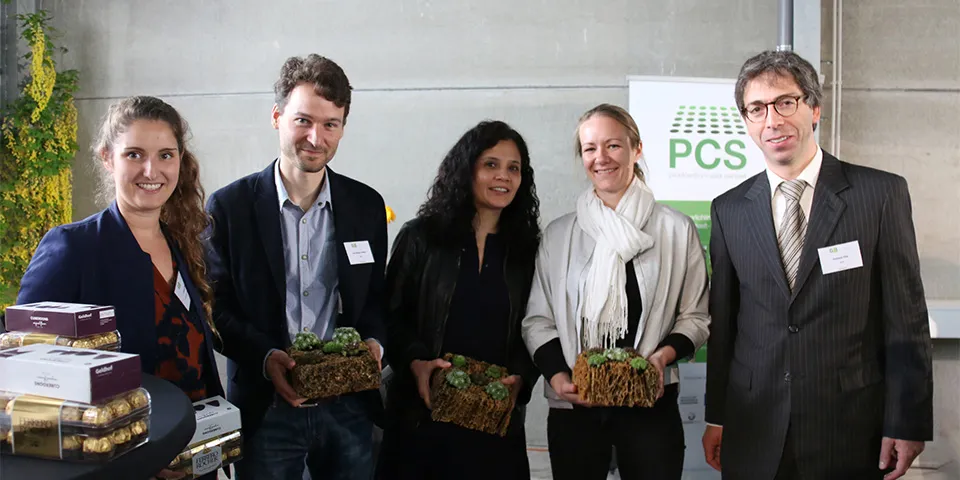
Green façades offer a solution for climate-resilient, sustainable cities: integrating more plants into façades is essential to tackle extreme temperatures, heavy rainfall and declining biodiversity in urban areas. How we can all green our walls with plants was demonstrated on a scientific and practical basis by leading international speakers and specialists from research centres WTCB, PCS and Centexbel, Universiteit Antwerpen and trade organisations NAV, VCB, Bouwunie, AVBS and BFG at the ‘Green façades: building blocks for climate-adaptive cities’ event, held at PCS in Destelbergen on Monday 20 May 2019. The days of dull grey façades on our streets are over: air-purifying living walls are the new trend.
Bruno Gobin, Director of PCS.
Green, living façades are in vogue. They not only enhance the appearance of buildings, but also make an important contribution to the climate indoors and outdoors, as well as to biodiversity. Vertical greenery improves summer comfort in buildings and cities by reducing the urban heat island effect, absorbing sound and filtering fine particulate matter from the air. Green walls can be used effectively as noise barriers alongside roads or as visually appealing sound-absorbing panels in meeting rooms or atriums. They can boost the quality of life for everyone: in hospitals and care facilities they can help patients recover faster, while in offices they can increase productivity. They benefit both the climate and the wallet. Several types of green wall are possible. Ground-based green walls have plants rooted in the ground at the foot of a façade, while LWS (Living Wall Systems) have plants growing in an organic or inert substrate, without contact with the ground. Living Wall Systems require an irrigation system, making them more expensive than ground-based green walls. A list of companies that install green walls or supply components for them is available at www.gevelgroen.be.
Karl Clement, Chair of the Green Building Users’ Group.
Leading speakers from Belgium and abroad shared their knowledge with participants at the ‘Green façades’ study day at the Ornamental Plant Research Centre (PCS). Austria’s Vera Enzi, an international expert in green infrastructure, outlined European policy and presented inspiring projects from across Europe. Renowned Belgian architectural practice Xaveer De Geyter Architects (XDGA) presented ‘Melopee’, a ground-based green façade project in Ghent. Italian architectural practice BOERI presented its world-famous, pioneering green projects, including ‘Bosco Verticale’ in Milan and recent projects in the Low Countries: a green social housing tower in Eindhoven, a ‘vertical forest’ in Utrecht and ‘Palazzo Verde’ in Antwerp.
In the afternoon, specialists shared their expertise on green façades. Topics included plant selection, innovative substrates and climbing aids; water management (the volume of water supplied, water quality and wastewater recycling options); environmental aspects (findings from the LCA study, or Life Cycle Analysis); acoustics (measurements on green walls showing their potential for sound absorption); irrigation and maintenance (including an alternative irrigation system developed in Flanders and practical guidance on maintaining green walls); the relationship between vegetation and structures (with a focus on trees, root space and considerations for planting); and water purification (a feasibility study into the water-purifying capacity of green walls).
Roeland Samson, UniversiteitAntwerpen.
Prof. Roeland Samson of Universiteit Antwerpen demonstrated one of the key benefits of green façades: vertical gardens filter fine particulate matter and pollutants from the air. He presented supporting scientific research and outlined the factors to consider when optimising the air-purifying properties of green façades. Site selection and plant choice, among other things, play a major role. The point, then, is not simply to create green walls in certain locations, but also to build them in a specific way. Simon Perneel, Chair of the Belgian Federation for Green Façades and Roofs, looked to the future. Will we move towards blue-green cities, with more water and vegetation? What opportunities could this bring for wellbeing and prosperity in Flanders? The EcoCities project by UHasselt is mapping the ecosystem services provided by green façades and green roofs, and will produce a tool for calculating the economic value of green walls. This will undoubtedly be of great interest to local authorities, among others. Ir.-architect Filip Dobbels, project coordinator for ‘Green Building’ at WTCB, concluded the study day with a summary of the findings of the ‘Green Building, green façades for sustainable buildings and cities’ research project. With support from the Flemish Government (Vlaio), the Belgian Construction Research Centre (WTCB), ornamental plant research centre PCS, textile research centre Centexbel, Universiteit Antwerpen and trade organisations representing architects, builders and garden contractors (NAV, VCB, Bouwunie, AVBS, BFG) spent four years building up knowledge about green façades. Thanks to the ‘Green Building’ research project, Flanders now has more objective, evidence-based knowledge about the benefits and challenges of green walls, as well as stronger technical expertise in the methods and considerations involved. Existing systems, techniques and materials have been optimised and new ones developed. Innovations were assessed to support their practical implementation. For example, a growth limiter can help keep a ground-based green façade within bounds and reduce pruning. SAP (superabsorbent polymers) can significantly improve substrate quality, making green walls less vulnerable to prolonged drought. Research has shown that vine weevils can be controlled by applying nematodes, microscopic roundworms, through the irrigation water, simplifying maintenance. The range of plants suitable for green walls can be refined and expanded as a result of the research. Irrigation systems can now also be built in Flanders without the need to bring in companies from abroad. Climbing aids do not have to be made of stainless steel: innovative textile-based alternatives are also possible. Innovative sensor technology can help monitor LWS ‘smartly’ and adjust irrigation volumes to plant requirements and the climate. The cost of green walls can be controlled through good design, with maintenance access playing an important role, and by opting for relatively simple, robust solutions wherever possible, without unnecessary complexity. This will enable green walls to be used on a larger scale in Flanders. Greenery can now also be incorporated into high-rise apartment buildings. A well-known example is architect Boeri’s ‘Bosco Verticale’ in Milan, but as of 2019, projects of this kind are also feasible in Flanders: the expertise is now in place.
The project results will continue to be shared via the project website www.gevelgroen.be. It features an up-to-date overview of projects in Flanders. A neutral specification text to make it easier for architects to incorporate green walls into their projects, a plant list and scientific reports will be available there at the end of October 2019, when the project concludes. As demonstrated at the study day, green walls provide significant added value for cities, particularly in locations with high concentrations of fine particulate matter and/or high noise levels. They are building blocks for climate-adaptive cities. They should therefore be promoted more actively, for example through subsidies that take location into account. Thanks to research and development in recent years, Flanders’ relatively young green wall sector has matured and is ready to deliver many more, higher-quality green walls. Let us seize this opportunity together to green urban areas in Flanders and improve our prosperity and wellbeing.
Question about this story? Ask your question
Keep following this
Get an email when a new story is published. No account needed.
- ThemeGreen space for everyone
- SubjectGeneral







