









Hugo Maes is an expert grower of kermes oak and holm oak
Hugo Maes, a renowned perennial plant grower from Waregem, loves spending time in nature.
From chance discovery to core business
About ten years ago, while walking through a high-altitude woodland in southern Europe, he became intrigued by the acorns of Quercus ilex (holm oak) and Quercus coccifera (kermes oak) scattered across the ground. He decided to take some home and try growing them. Today, the project is his core business.
Words Philip Doutreligne | Photography Hugo Maes
Carefully grown
He still travels abroad every year to collect acorns. The plants already growing in our country are still too young to produce fruit themselves. He also only uses acorns from plants with small leaves. This allows them to be pruned into neat, crisp shapes and form a dense canopy.
The young plants adapt easily to our climate. They are regularly potted on into increasingly large containers until they reach the required size. Maes’s current range of Quercus ilex is available in sizes from 30/40 cm to 100/125 cm. The site where he carefully grows the young plants now covers more than a hectare, but is in urgent need of expansion.
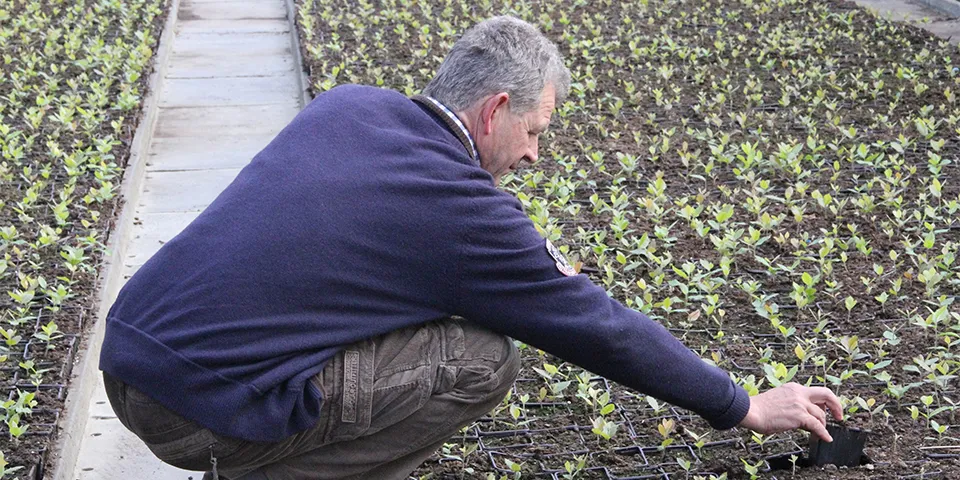
Hugo Maes checks some young cuttings being grown on.
Beautiful and evergreen
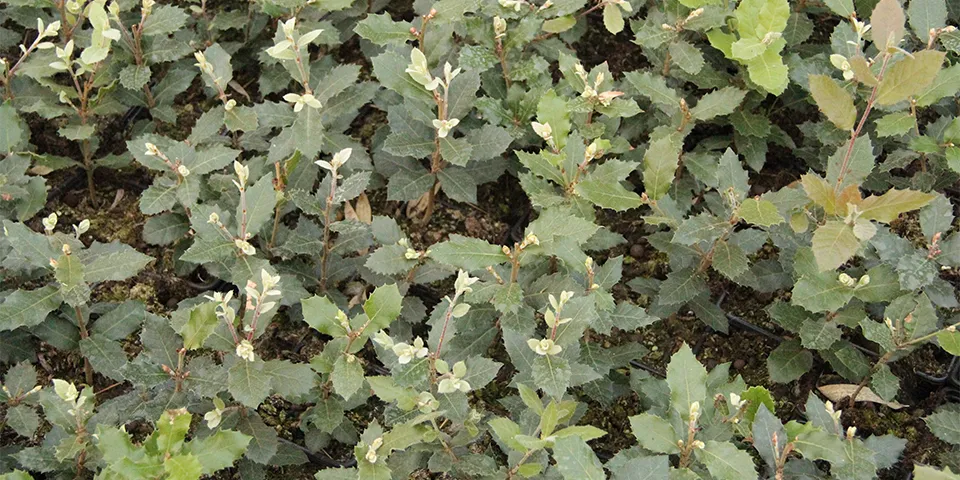
Quercus ilex is a particularly attractive plant, with smooth or toothed, leathery, dark green leaves. The undersides of the leaves are silvery grey. In May and June, the holm oak produces an abundance of pale yellow flowers. The plant can withstand even the harshest winters without difficulty and remains largely evergreen.
A plant for the future
Quercus ilex will undoubtedly become even more popular. It is resistant to diseases and insects, and can tolerate extreme heat and drought once well established. Kermes oak can even grow in gravelly soil! With temperatures rising and heatwaves becoming increasingly common in our region, Quercus ilex and Quercus coccifera offer promising prospects. Kermes oak is also an ideal alternative to box, which is increasingly under attack from box tree moth. Its small leaves mean kermes oak can be clipped into an equally attractive ball shape.
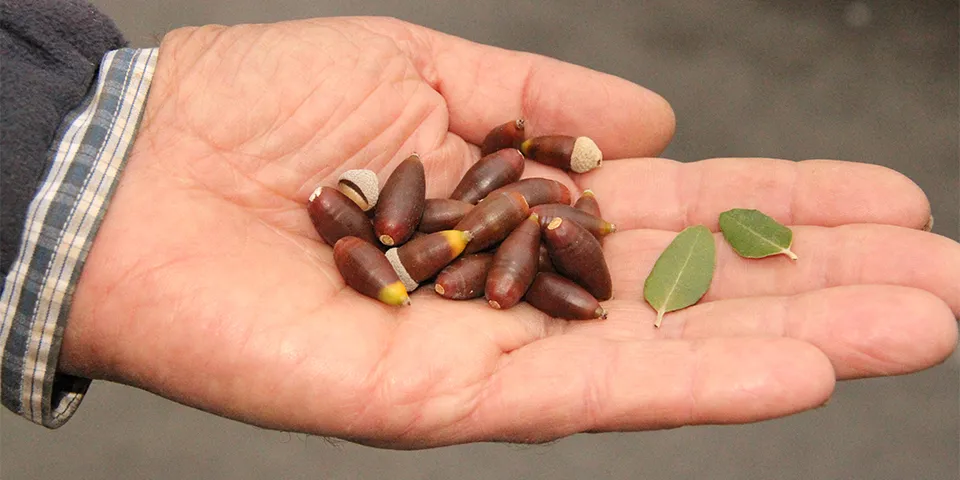
A selection of carefully chosen acorns.
For every type of planting
In its natural habitat, holm oak can grow into a tall tree. However, the young plants respond well to topiary and can be kept perfectly in check, forming neat, compact, continuous hedges or looser shrubs. This makes them ideal for garden boundaries, creating garden rooms or as eye-catching mass plantings. Two trims a year, in April and September, are enough to maintain a neat hedge. Quercus coccifera is also ideal for use as ground cover.
Recognition from industry professionals
Hugo Maes’s pioneering work is gradually bearing fruit, including among industry professionals. Many landscapers and garden designers already use his plants in their own gardens. They are also increasingly specifying native Quercus in their contracts instead of imported species, giving their clients confidence that the plants can cope with our changeable climate.
For large-scale projects too
Quercus ilex and Quercus coccifera are suitable not only for private gardens, but are also increasingly appearing in larger projects such as residential developments, apartment complexes and public buildings. Here too, factors such as disease resistance, aesthetics, winter hardiness and low maintenance are decisive. Notable recent projects featuring substantial plantings of holm oak and kermes oak include ‘Duinenwater’ in Knokke and ‘Parkresidentie Ter Vichte Resort’ in Anzegem-Vichte.
Question about this story? Ask your question
Keep following this
Get an email when a new story is published. No account needed.
- SubjectGeneral







