









HUGSI, Husqvarna’s AI-powered index, offers new insights into urban vegetation
For the second year running, Husqvarna is presenting HUGSI (Husqvarna Urban Green Space Index), an AI-powered satellite system that helps policymakers around the world monitor the extent and health of green spaces in cities.
It turns out that urban areas around the world are not getting greener on average, while urban areas in Europe are greener than average. Charlotte, North Carolina, USA, was named Global Green Model City 2020, the greenest city in the world. But what about Brussels, last year’s winner in the ‘best health of urban vegetation’ category?
Just how green are cities around the world? Are they getting greener, or is urban densification also squeezing out valuable green space? HUGSI was set up to help protect urban greenery and provide stakeholders with unique data on the current state and development of vegetation. After all, green spaces are the lungs of a city. They improve air quality and help manage rainwater and flooding, while supporting citizens’ physical and mental health.
What makes a city green according to HUGSI?
By applying computer vision and deep learning techniques to satellite images, HUGSI provides insight into the current state and historical development of vegetation and its surroundings in urban areas.
The HUGSI 2020 index provides insight into greenery in 155 cities across 60 countries, assessed against a number of green Key Performance Indicators (KPIs):
- Percentage of the city that is green
- Percentage of the urban area covered by trees
- Percentage of the urban area covered by grass
- Health of the vegetation
- Distribution of green space
- Green space per capita
To score well in the index, selected cities must have healthy, well-distributed vegetation, with a high proportion of it in densely populated areas. Trees are given twice the value of grass.
At a glance
Charlotte, North Carolina, USA was voted Global Green Model City 2020, the greenest city in the index this year. It achieved the highest score for the proportion of green space, combined with good distribution and healthy vegetation. This year, Vilnius, the capital of Lithuania, took the honour of being the highest-ranking European city.
Urban areas in Europe are greener than average, at 45% compared with the global average of 39%. European cities also expanded their green space by more than 40 million m².
What about Belgium?
Brussels, the only Belgian city monitored, ranks 73rd in the overall ranking.
Last year, it topped the ‘best health of urban vegetation’ category, but this year our capital ranks joint 7th. This is not so much because the city has fallen sharply in this category, but rather because many more cities were included in the HUGSI list this year.
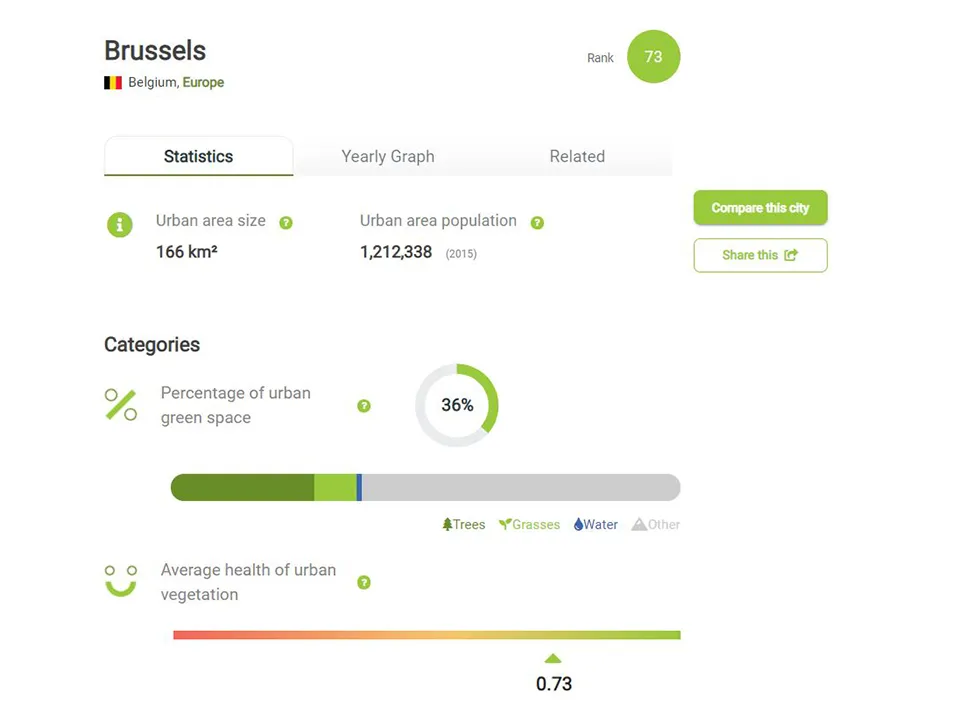
All the KPIs for Brussels and the other cities included can be viewed at: www.hugsi.green.
The Husqvarna Urban Green Index was launched in 2019 at the Husqvarna Living City Congress in Gothenburg, Sweden, a gathering of international thought leaders and professionals from industry and the media, all working in the field of green space.
Question about this story? Ask your question
Keep following this
Get an email when a new story is published. No account needed.
- SubjectGeneral







