









Oak in focus: Quercus ilex in shrub form
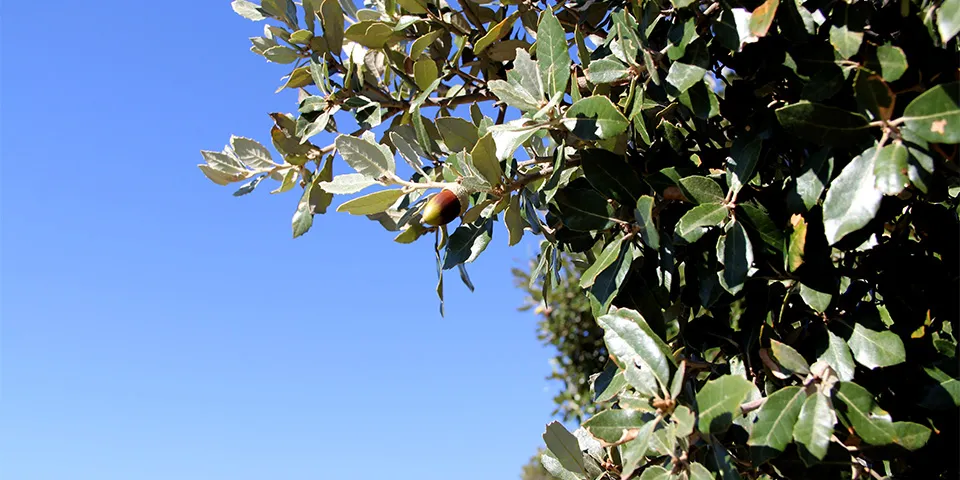
Over the years, Hugo Maes of the eponymous perennial nursery has developed a passion for oaks, particularly Quercus ilex (holm oak) and its smaller relative, Quercus coccifera (kermes oak). Both varieties thrive in our soil and climate, often in shrub form, and are becoming increasingly popular in Flemish gardens. Hugo first had the idea of growing holm oak himself at a French monastery. A divine inspiration?
Home-grown
Quercus ilex is one of the most common woody plants in southern Europe and North Africa. That is why Hugo Maes travels to the south of France every year. High up in the cold hills of the Garrigue, with their limestone-rich soils, he collects the ripe, pointed acorns of the holm oak. He germinates them himself and grows them into shrubs and hedge plants. The care taken during cultivation allows the plants to adapt to our climate and soil conditions, and makes them hardy to at least -18°C. Regular pruning and meticulous care of the young plants ensure they develop into well-branched, bushy specimens that establish quickly in their new surroundings after transplanting. By selecting the seeds himself with great care, he has ensured that locally grown holm oaks have much smaller leaves than imported Italian specimens. Hugo Maes’s years of pioneering work have led to more and more garden designers specifying Belgian-grown plants in their plans, specifically because of their leaf shape and size. Garden designers are also increasingly planting holm oak in their own gardens, which speaks volumes.
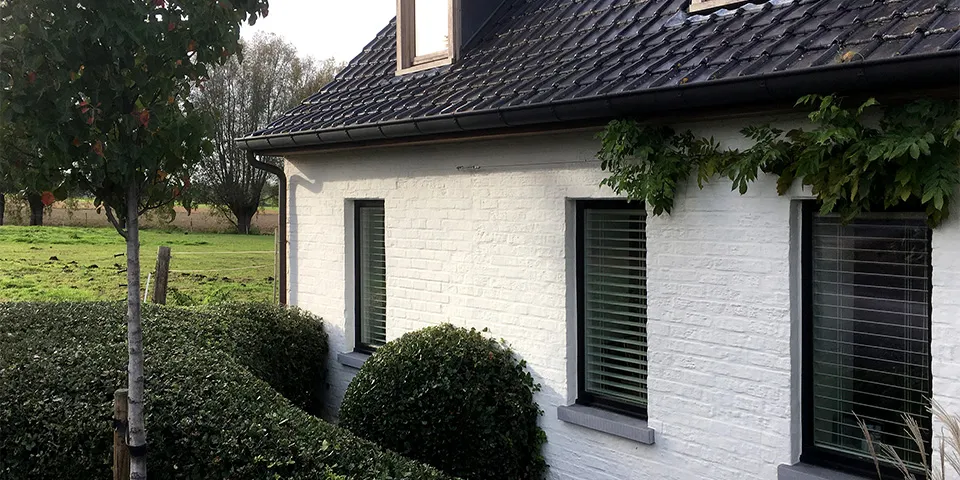
Decorative evergreen foliage
The holm oak is characterised by its evergreen, somewhat leathery leaves, which are glossy on top and felt-grey to silvery underneath, with smooth or holly-like toothed edges. Although Quercus ilex is evergreen, it may lose some of its leaves during prolonged cold spells. These are immediately replaced by fresh new growth.
This evergreen quality makes holm oak particularly popular for hedging and mass planting.
A range of pruning styles
Quercus ilex is slow-growing, making it ideal for all kinds of pruning styles. One trim a year is enough to keep it in check. For a neater look, two trims are best, one in spring and one in autumn. It can easily be pruned into a variety of shapes: as a ball-shaped shrub or small tree, in cloud form, or as a crisp, straight-edged block in modern gardens. Even left unpruned and informal, the holm oak remains highly appealing.
Versatile
The uses of holm oak are almost unlimited. It has become a formidable competitor to box balls, box mass plantings and hedges, both large- and small-leaved. Holm oak is also increasingly used as an alternative to holly hedges and hornbeam, or as a windbreak in coastal gardens. Quercus ilex also performs particularly well as an underplanting, a ground cover and a resilient, low-maintenance planting on verges and embankments. As a hedge, holm oak also provides an ideal green backdrop for grey-leaved plants.
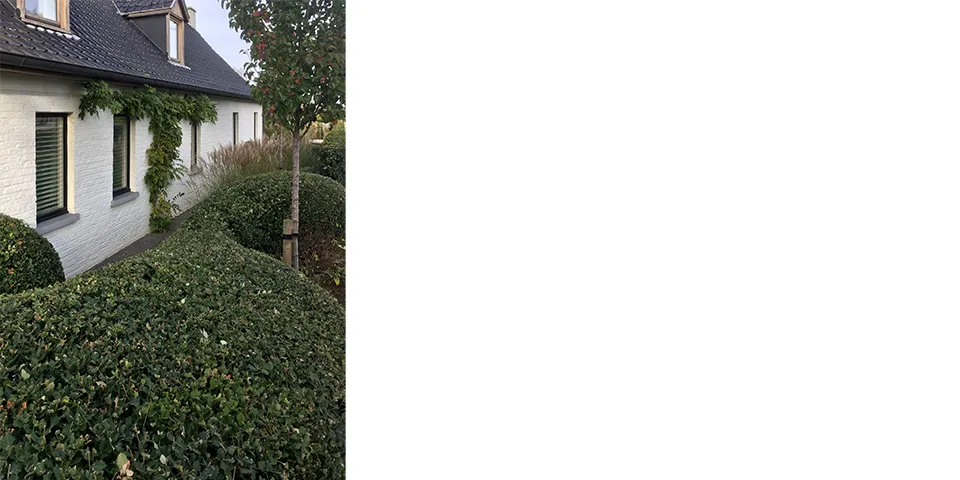
Quercus ilex pruned into cloud form.
Particularly resilient
Plant diseases and pest infestations have always existed. However, global trade means that insects and diseases from other continents can reach our regions more quickly and easily, where they cause considerable damage. The spread of the difficult-to-control box tree moth and the vine weevil are just two examples. They have become formidable enemies of our traditional hedges, driving demand for resilient plants to an all-time high. Quercus ilex is unaffected by these pests and diseases and can readily withstand such threats. Alongside holly, holm oak is therefore emerging as the best alternative to traditional box planting.
Suited to our climate
We face a number of unavoidable climate changes, with extreme conditions becoming increasingly common. Periods of heavy rainfall alternate with searing heat and drought. Many plants struggle with this, but not the holm oak. It thrives in our climate and will grow well in all conditions, provided the soil is sufficiently rich in lime and well drained. Quercus ilex also feels at home in the saline, often windy coastal climate, which is why it is often planted as an evergreen windbreak that provides privacy in both winter and summer.
Miniature version
The kermes oak, or Quercus coccifera, is a miniature version of Quercus ilex. It is also known as holly oak because of its small, hard, spiny leaves. Quercus coccifera is smaller and more compact than holm oak in every respect. In southern Europe, it is abundant as an impenetrable understorey in woodlands. In spring, the kermes oak takes on a soft bronze colour. In our regions, it is a valuable alternative to traditional bedding plants. As a low-maintenance ground cover, kermes oak also looks particularly attractive beneath holm oak trees.
For more information: www.vasteplantenhugomaes.be
Question about this story? Ask your question
Keep following this
Get an email when a new story is published. No account needed.
- SubjectGeneral







