









Rapid construction of a concrete swimming pool
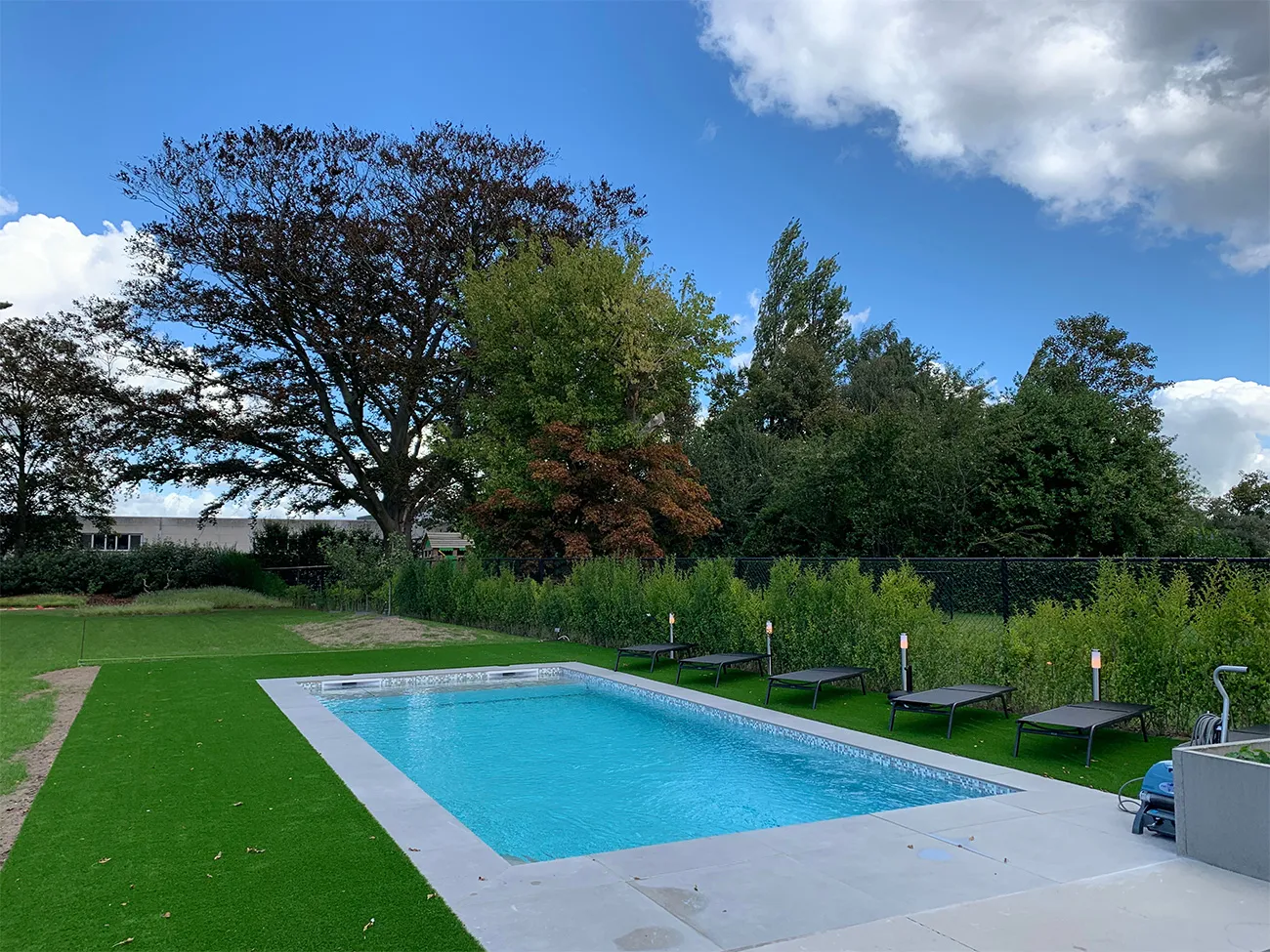
In April 2020, while most Belgians were still getting used to the idea of a lockdown, pool builder Carlos Foubert of CT Pools was asked by a forward-thinking customer to install a swimming pool as quickly as possible.
Not just any pool, but a stylish mosaic pool with an underwater bench. By using formwork cleverly, among other things, Foubert managed to combine the high aesthetic standards with a tight completion deadline.
Poured concrete
“A pool like this can only be built using poured concrete,” says Foubert. “A prefabricated polypropylene pool is a good alternative if you are using a liner, but a concrete pool is essential if the finish is to be natural stone, ceramic tiles or mosaic. Even a brick-built shell would not be sufficient here, though. Mosaic, for example, requires the shell to be completely watertight. To be absolutely certain of that and provide the necessary strength, we always opt for 30-centimetre-thick walls rather than the standard 25 centimetres.”
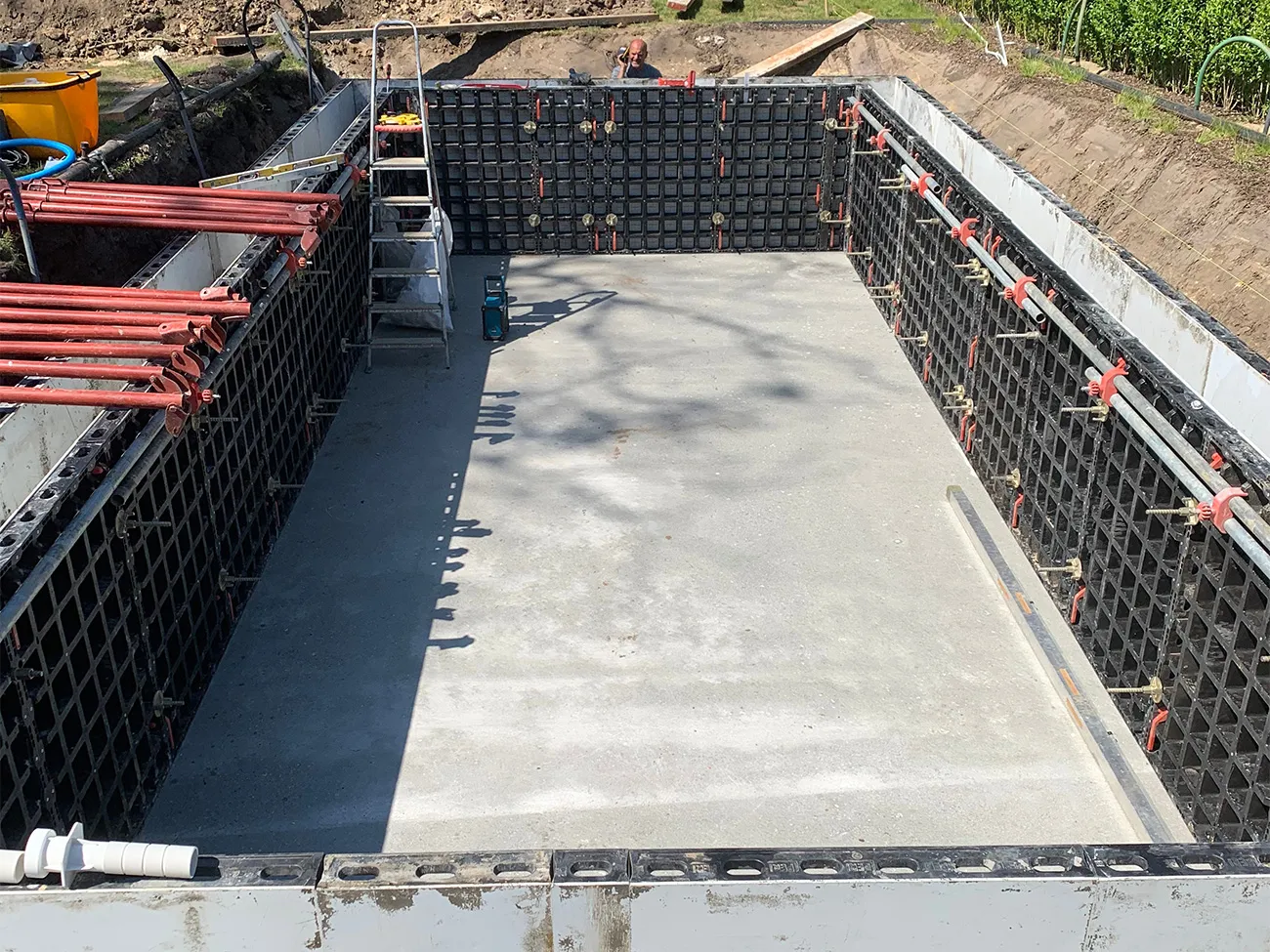
However, the choice of poured concrete, particularly in combination with mosaic pool tiling, has significant implications for the installation schedule. “Concrete takes time to cure. There’s no getting around that. The same applies to the adhesive used to fix and grout the mosaic tiles. In other words, we had to allow for two waiting periods of 21 days each on this project. And yet the pool was ready for swimming by early August.”
Efficient formwork installation and removal
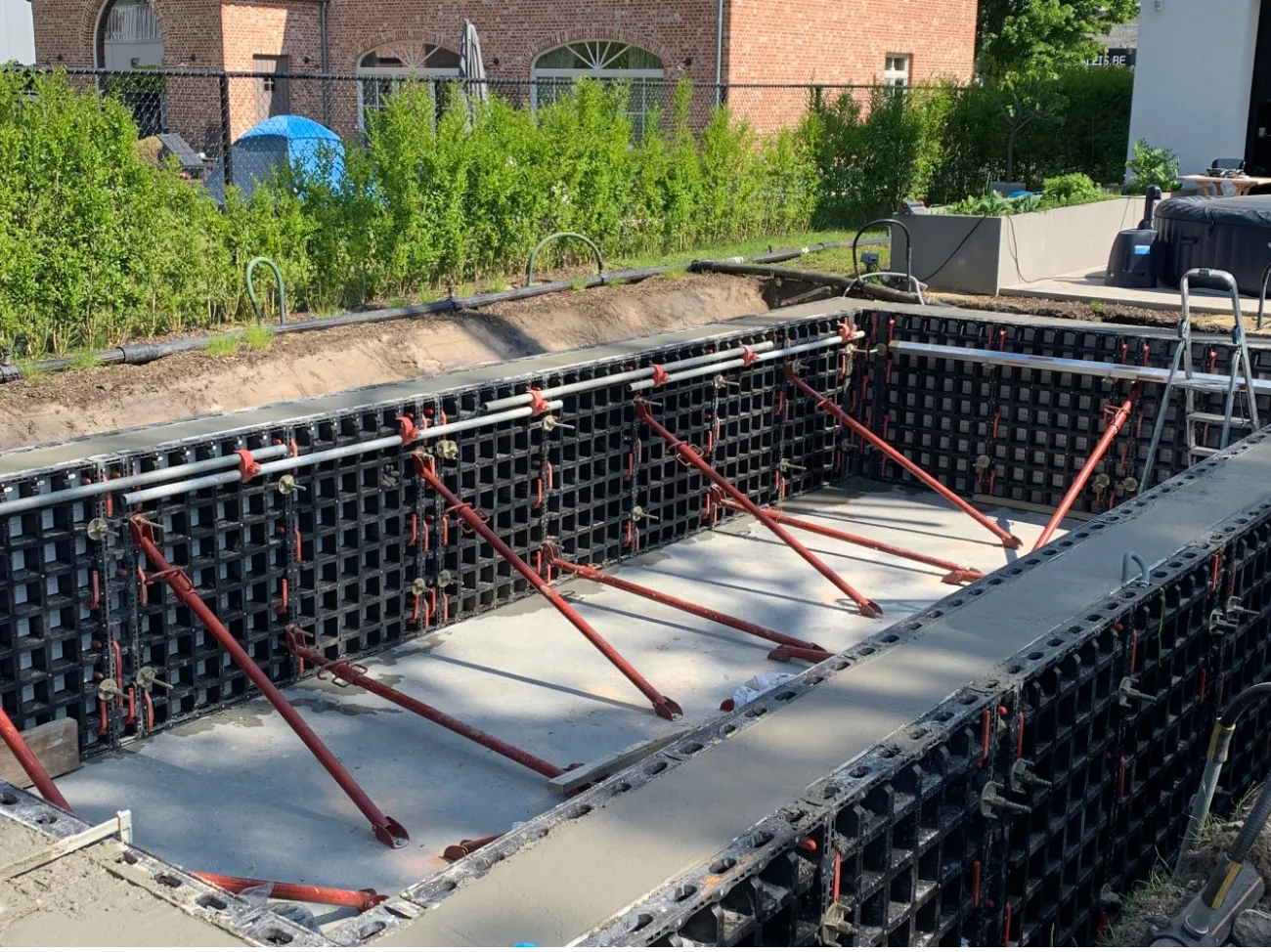
Foubert made significant time savings during formwork installation. “Since 2019, we have been using the PERI DUO modular formwork system. It is perfectly suited to withstand the pressure of 30 centimetres of concrete and works a bit like a giant Lego set, with the formwork panels assembled into the required configuration using red connectors. The lightweight plastic panels bring considerable savings in materials and transport, and make installation much easier. We don’t need a crane for this system. Each panel can be carried by one person or even lifted in and out of the excavation, and two of us completed all the formwork for this pool in a single day. Stripping, cleaning and loading the panels takes around fifteen man-hours.”
Tailored to the pool
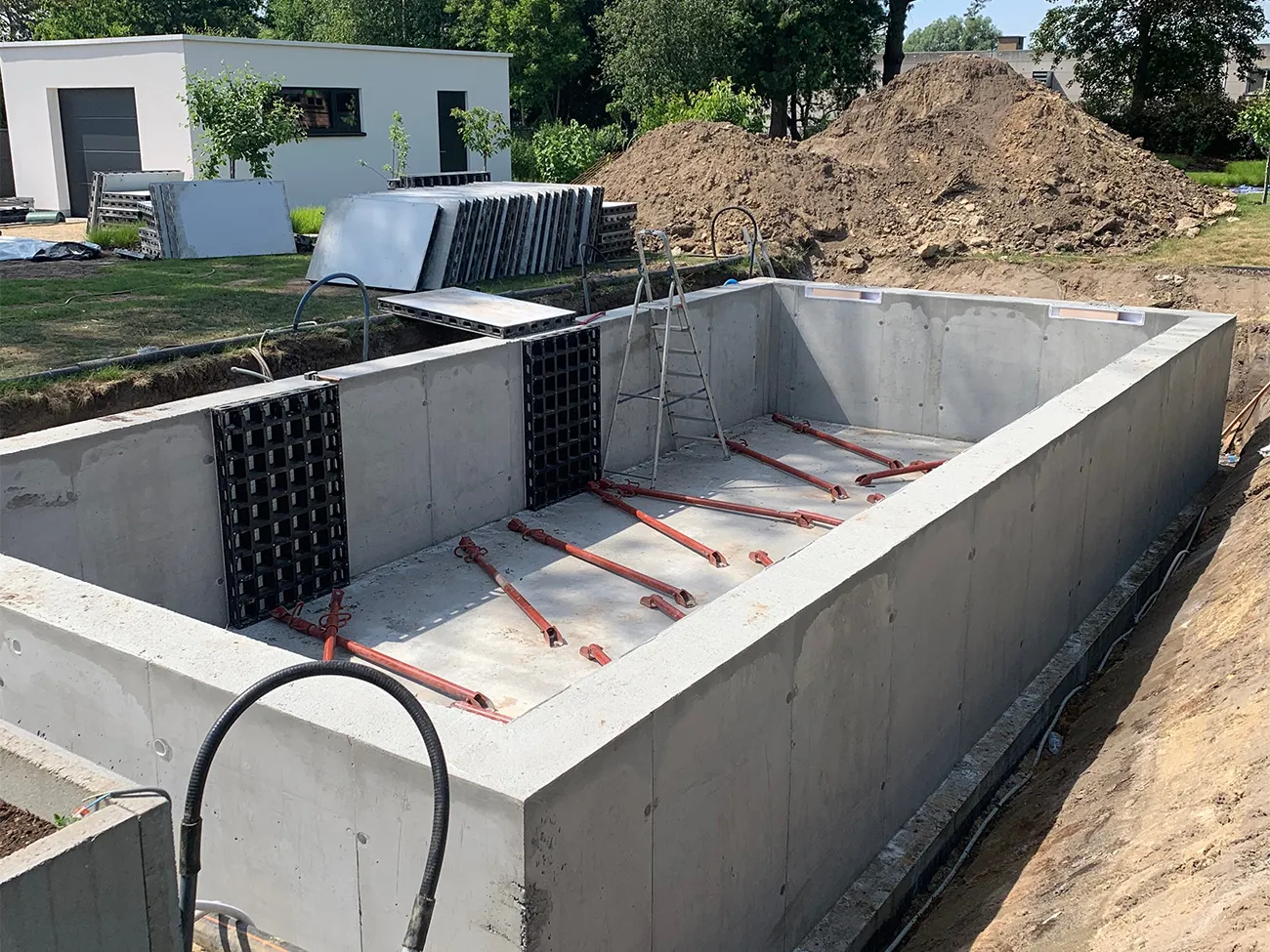
According to Foubert, the various formwork panels in the PERI DUO range are perfectly suited to pool construction. “The largest panel measures 90×135 centimetres and can easily be extended to 90×150 centimetres using a compensating panel. This allows us to tailor the pool depth to the user. A depth of 150 centimetres is often used as the standard for a swimming pool, but if the user is on the shorter side, as in this case, we prefer 135 centimetres. That way, everyone in the household can use the pool comfortably.”
The 9×3.9-metre pool was fully formed using PERI DUO panels, and the wall penetrations were installed during formwork assembly. “Most of the penetrations, such as the inlets, are 30 centimetres, so we could fit them neatly between the panels. PERI DUO also has fixing points every 15 centimetres, which made them quick and easy to install. We only had to form a small section by hand around the skimmers, which are just 19 centimetres deep. These details also ultimately save time.”
Question about this story? Ask your question
Keep following this
Get an email when a new story is published. No account needed.
- ThemeWater and hard landscaping in the garden
- SubjectGeneral







