









The 6 new living environments for a green and healthy setting
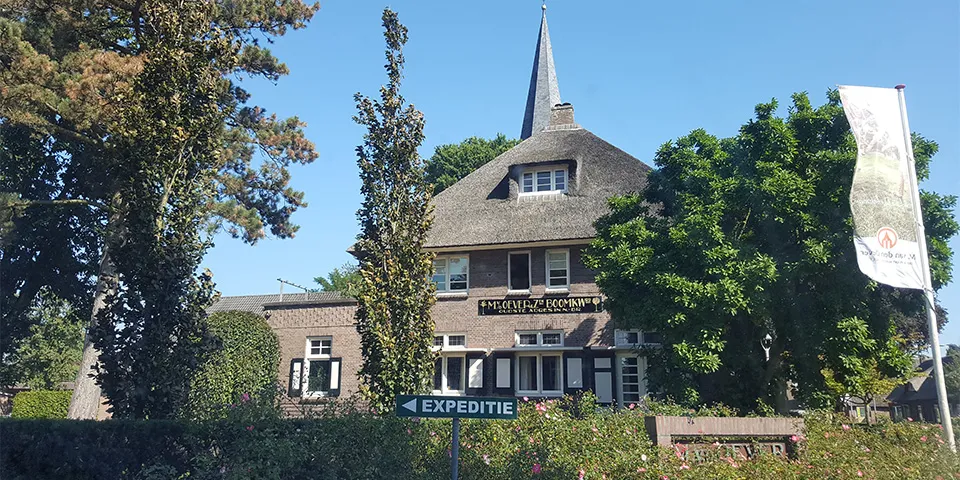
It was not so long ago that many businesses took a purely product-oriented approach. Today, however, the challenge of creating healthy environments is framed so holistically that it is almost impossible to separate specialisation in in-depth product knowledge from green-space advice. “This means we need to think about location, space and the brief from the outset, so we can deliver the best possible results in terms of both usability and green quality in a living environment,” says Marwin Dekkers, Managing Director of tree nursery and green-space consultancy M. van den Oever.
“Ten years ago and earlier, we were mainly focused on creating aesthetic value: what kind of look did we want to create? That has long since changed. Healthy neighbourhoods, climate-adaptive neighbourhoods and active neighbourhoods are now the order of the day. But there is still a lot to do.” As Managing Director of M. van den Oever, a company that has specialised in green-space consultancy for almost 230 years, Dekkers is committed to creating healthy living environments across Belgium, the Netherlands and Europe.
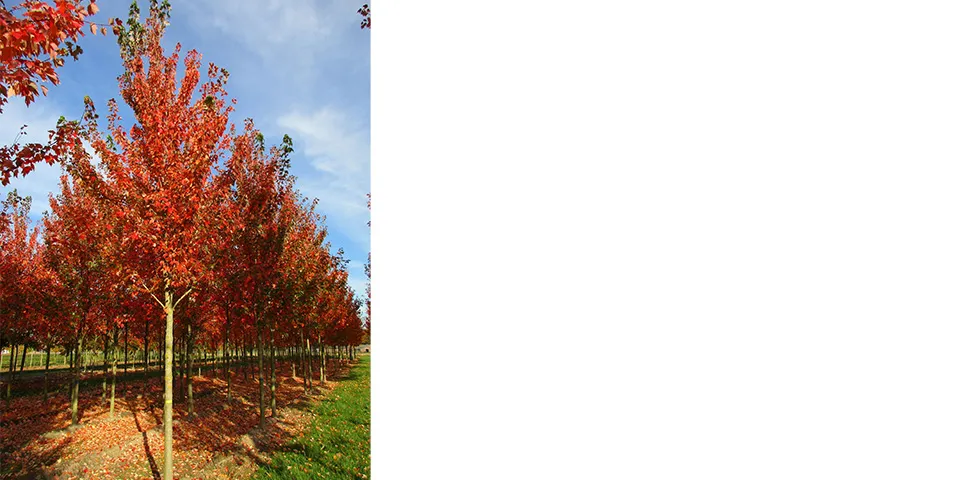
ColourSpace™ Acer Rubrum Franksred in autumn colours.
5 green-space challenges
That is easier said than done, with one urgent issue after another emerging. The company has therefore identified five green pillars, or green-space challenges, that highlight the importance of green environments:
• Climate, because greenery makes an environment more climate-resilient through measures including water storage, water infiltration and drought-tolerant plants.
• Wellbeing, because greenery gets both young and old outdoors, encourages physical activity and social interaction, and has a positive effect on health.
• Economy, because greener environments are valued more highly by users, boosting property values and economic spending.
• Biodiversity, because greenery enhances people’s experience of an environment, provides food and safety for people and animals, attracts more bees, insects and birds, and reduces soil desiccation.
• Future-proofing, because greenery planted now must remain in place for at least two to three generations to make the greatest possible contribution to the other pillars. This is also much more sustainable than designing for circularity.
Dekkers wants to dwell on the economy pillar: “User surveys show that the quality of an environment is determined at least 45 per cent by the greenery present, including green façades, with figures rising to as much as 75%. That is enormous. Yet when a new square or park is developed, barely one or two per cent of the investment is spent on greenery, or is left for it, I should say. Something is clearly going very wrong in our designs and construction projects!”
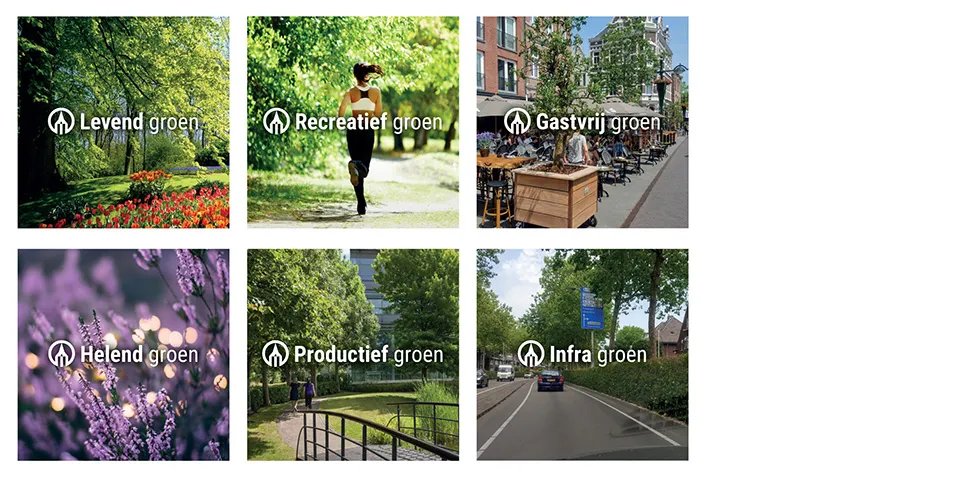
The 6 new GreenLife™ living environments.
6 new living environments of the future
M. van den Oever has translated these pillars into six typical user-focused environments. They can serve as a guide to shaping and designing an environment with a specific, clearly defined purpose. Green solutions have been identified for each environment to optimise its function. “The great thing is that each type of environment is often connected to the others in some way. That lets you combine objectives,” says Dekkers.
Living greenery
Also known as: every opportunity to green areas smaller than 400 m2. “Along streets and cycle paths, outside people’s front doors, in neighbourhoods: there are so many opportunities in places that are currently asphalted or paved. You should always use our three-layer approach here, for example combining different types of grass or flower mixes with shrubs and trees, and mowing less to encourage biodiversity.”
Recreational greenery
Small and large parks for recreation, socialising and events. “And we’d like to go on strike there sometime too,” jokes Dekkers. “Recreational green spaces should above all be designed for children to play in and older people to relax, for example by adding water, while also taking animals and ecological corridors into account.”
Welcoming greenery
Greenery that invites people to spend time there, while also increasing the value of nearby amenities and encouraging recreation and spending. “So this is the opposite of a concrete shopping street or ‘Christmas lights added in a hurry’. Add quality to enhance the experience. Take Efteling or Plopsa: these parks would not have become such huge successes if so much thought had not gone into the greenery.”
Healing greenery
Learning, relaxing, healing. “These are all things greenery can do, through knowledge of species that stimulate, engage and relax. For example, the walnut (Juglans regia) is a tree that can provide year-round benefits in a care setting: it is a mega-filter for solar radiation, provides immediate cooling equivalent to 10 air conditioners, and you can enjoy walnuts throughout the year, which also help protect against mosquitoes when in season.”
Productive greenery
Views of greenery give people the respite they need while working and help reduce sickness absence, while greenery can also increase rental and property values. “Greenery in a business park encourages employees to eat outside or go for a walk. It also creates opportunities to install an exercise bench or fitness equipment to encourage physical activity. In well-designed business parks, finding new employees is no problem.”
Green infrastructure
Greenery that supports our climate, for example by capturing particulate matter and allowing water to infiltrate. “We are very glad that wealthy people in the Golden Age came up with the idea of planting trees along the canals for the ‘cieraet ende plaisantie’ of the streetscape. They are doing a lot of good now. Armies also needed protection from the elements during the wars, which is where much of our current green infrastructure originated. We are now using it more to make environments biodiverse and climate-resilient.”
FREE Greening book and presentation
Dekkers will present the method for Greening the six living environments, along with concrete green solutions such as ClimateTrees™, PlayGreen™, EatMe™, BirdTrees™, ColourSpace™ and more, in a keynote presentation at De Dag van de Openbare Ruimte in Brussels on 6 February 2020. M. van den Oever will of course also be exhibiting.
You can now request this presentation and a beautiful FREE book, ‘Prettige Plekken’, on green quality and usability, featuring images from across Europe, via the link www.vergroen.nu!
Haaren in North Brabant: Europe’s green nursery
Since 1791, tree nursery M. van den Oever in Haaren, North Brabant, has been one of the largest nurseries, located on ideal loamy sandy soil and playing a pioneering role in sustainable cultivation and green-space consultancy in the Netherlands and beyond. It works with around fifty quality-selected green suppliers in the region.
This approach produces healthier, stronger plants and trees for its customers, as well as a comprehensive green range of 12,000 varieties, with support provided right through to the client’s project.
The nursery supplies cities and municipalities, landscaping businesses, water boards and construction companies across Europe, from Belgium, France, Germany and Denmark to Sweden, England, Austria and Switzerland. Haaren proudly fulfils its role as a sustainable nursery for a greener Europe.
Question about this story? Ask your question
Keep following this
Get an email when a new story is published. No account needed.
- SubjectGeneral







