









The right care makes for strong plants: how to get bay laurel through the winter

Alongside its evergreen nature and the many options for pruning into shape and choosing the right size, durability and strength often play a decisive role when selecting bay laurel.
Even strong plants need the right care. What’s more, winter is when the foundations are laid for plants and trees to thrive for the rest of the year.
Bay laurel is an exceptionally strong, evergreen plant that can generally remain outdoors well into autumn. However, it is not fully hardy in our climate. It can withstand light, short-lived frosts of around -5°C without any problem, but prolonged frost will cause it to dry out or damage its trunk or crown. Topiary plants in particular can lose their aesthetic appeal as a result. So when severe frost is forecast, or frost is expected to last for several days, action is needed. There are two options: bring the plant indoors to overwinter, or wrap it in suitable materials.

Overwintering indoors
Where possible, it is advisable to bring bay laurel indoors to overwinter as soon as the first prolonged frosts set in. Temperature, light, air and water are the main factors to consider.
When it comes to temperature, the principle is that ‘cold makes strong’. Plants do not need to be kept in a heated room, but should overwinter in a place that is as close as possible to the outdoor temperature while remaining frost-free.
Light is not essential in winter, when the plant is dormant. Plants can therefore overwinter in a garage, garden shed or dark storage building.
Regular ventilation, on the other hand, is essential, particularly to prevent disease and pests.
Finally, bay laurel also needs water in winter. A plant overwintering indoors depends entirely on manual watering. As a rule, watering every two to three weeks is recommended, although the exact frequency depends on the temperature and amount of light.
Or perhaps a winter coat?
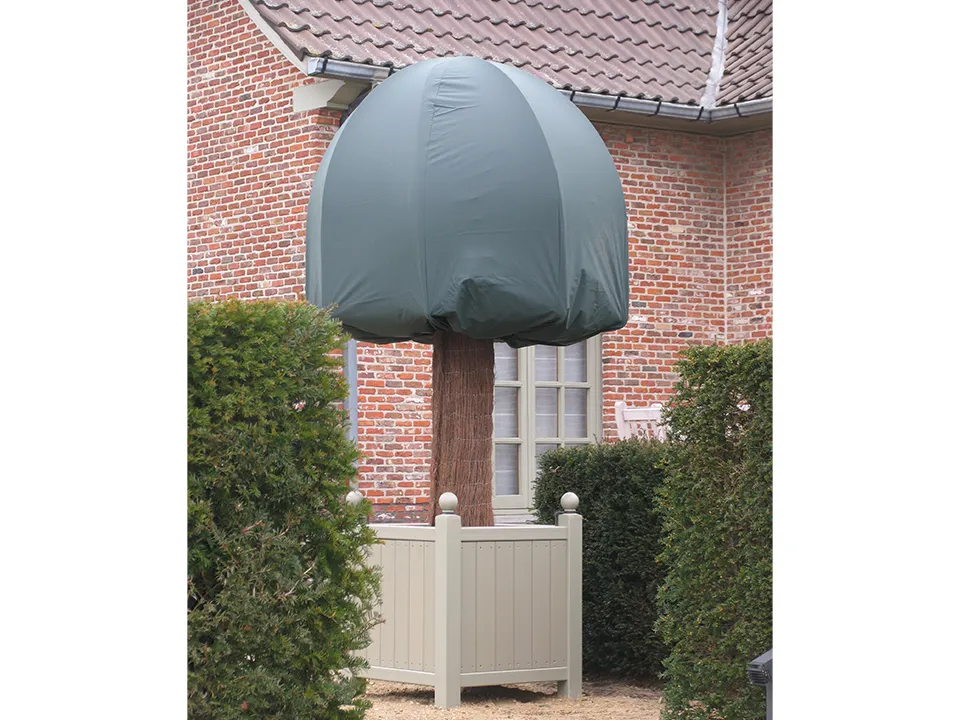
If there is no indoor space available or the plants are too large to move, bay laurel can also be wrapped. This method does require a little more attention, however, and can never offer a 100 per cent guarantee during prolonged frost.
To protect the plant as well as possible from frost, the crown and trunk must both be insulated, as well as the root ball. One option is to wrap the pot and add a layer of straw on top of the potting soil. If the root ball is not adequately protected, the water in the soil will freeze, eventually causing the plant to dry out.
Although this thorough wrapping is necessary to protect the plant from frost, it also carries some risks. Moisture can build up beneath the covering, leading to mould. It is therefore essential to use breathable materials such as jute or fleece, and to ensure that plants are not left wrapped for any longer than absolutely necessary. In other words, if milder weather is forecast after a week of frost, the plant should be unwrapped. During periods with overnight frost but fine days, it may be enough to open the covering during the day to ventilate the plant.
On site
Unlike overwintering indoors, a winter coat offers less certainty and requires more intervention and closer attention to the weather. For this reason, Laurica-Plants offers clients the option of having plants from projects and private gardens overwinter at the Lauretum in Jabbeke.
Ready for spring
Once the worst of the overnight frosts are over, usually in March, the plants can be put back outdoors. Plants that are still fully dormant and are moved outside early will tolerate the cold better. A prolonged or excessively warm period indoors, on the other hand, will cause plants to start growing too early.
Ideally, bay laurel should be pruned into shape while dormant over winter, and fertiliser should be applied just before spring so that the plant has enough nutrients to produce a fresh flush of green leaves.
Question about this story? Ask your question
Companies in this story

Keep following this
Get an email when a new story is published. No account needed.
- SubjectGeneral
- CompanyLaurica Plants







