









Towards an integrated approach to infiltration and depaving
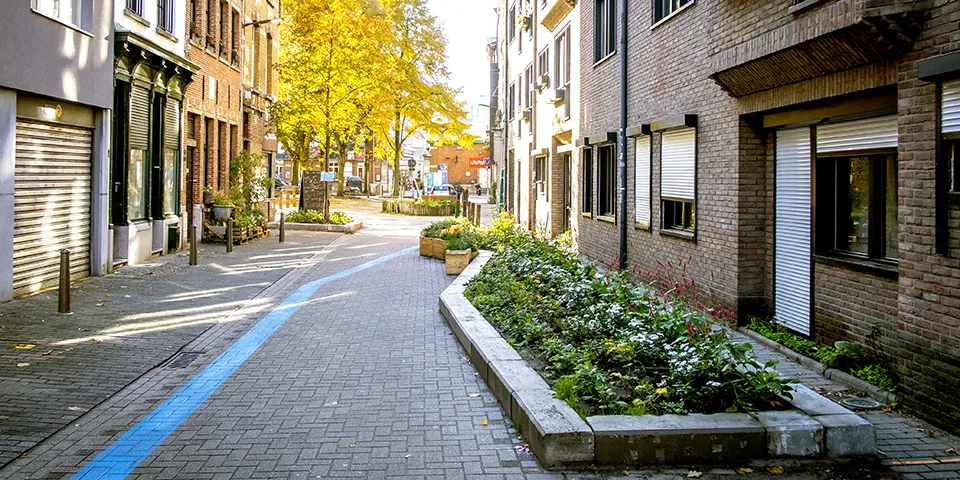
The dry summers of 2017 and 2018 are still fresh in our minds. Like local, sometimes intense, downpours, they are a sign that climate change is making itself felt. But how can we limit the flooding caused by these downpours? And how can we capture this precious rainwater and put it to good use to help tackle drought? Recent research by Patrick Willems, professor of hydraulic engineering at KU Leuven, shows that depaving could be one of the keys to the solution. According to Willems, disconnecting enough paved surfaces from the sewer system, combined with infiltration, is crucial to adapting to changing climate conditions.
Aquafin has been working for some time on solutions for managing water intelligently. One example is its rainwater plans, which assess how best to manage rainwater for each municipality. The wastewater treatment company is now developing a concept to put into practice the climate-resilient ideas generated by these plans. Krista Decat, Vision Manager at Aquafin, explains: “Our new concept picks up where the rainwater plans leave off. While a rainwater plan looks at a larger area and provides an overall perspective, our new concept focuses on specific project areas and examines all the water flows there. We consider how green-blue infrastructure can be put into practice, offering the best solution for a particular street, neighbourhood or district. We ensure not only that it works optimally, but also that it looks good.
Getting everyone on board
“Green-blue infrastructure can take many forms. Think of swales, depaving, infiltration strips or permeable paving, as well as green roofs or façade gardens, which we would ideally like to combine with the smart reuse of rainwater,” Krista Decat continues. “These measures are not new in themselves, but integrating them thoughtfully into an implementation project is. So is raising awareness among both the public and our technical partners. A key challenge is finding the right way to get our technical partners on board.”
Krista Decat, Vision Manager at Aquafin. (Image: Sigfrid Eggers)
In his speech at the Aquafin Awards in late 2018, Dirk De Waele, Director of Project Management, had already noted: “In general, too little attention is paid to source control measures that prevent rainwater runoff. If we are serious about the second part of Aquafin’s vision, namely ‘a living environment in harmony with water’, then we owe it to ourselves, our clients and society to act.” Decat adds: “Our concept therefore requires close cooperation with our technical partners. We need to strengthen our dialogue with them. They are the ones who will help design and implement our plans and ideas.”
Benefits that have a lasting impact
While this approach is still relatively new in Flanders, other countries are already further ahead. New York, for example, has been benefiting from green-blue infrastructure for some time. First and foremost, the results are immediately visible. It also makes neighbourhoods much more pleasant places to live, something conventional underground infrastructure works cannot offer. And for anyone who thinks this concept is an expensive measure, a study found that it is also significantly cheaper. “What’s more,” says Krista Decat, “the diversity of measures is precisely what makes your surroundings best adapted to changing or more extreme weather conditions.”
Today and tomorrow
Krista Decat: “We are targeting not only our traditional clients, such as municipalities, but also property developers, development companies, and businesses and organisations facing complex water challenges. We want to inspire them and help them develop and implement innovative, future-focused water concepts. We are already carrying out two such projects. For ZOO Planckendael, we are preparing a comprehensive water study focused on sustainably improving and optimising the various water flows in the park. Matexi, meanwhile, called on our expertise for advice on sustainable energy and water management for a new neighbourhood to be built at Drie Fonteinen in Vilvoorde.”
The dry summers of 2017 and 2018 are still fresh in our minds. Like local, sometimes intense, downpours, they are a sign that climate change is making itself felt. But how can we limit the flooding caused by these downpours? And how can we capture this precious rainwater and put it to good use to help tackle drought? Recent research by Patrick Willems, professor of hydraulic engineering at KU Leuven, shows that depaving could be one of the keys to the solution. According to Willems, disconnecting enough paved surfaces from the sewer system, combined with infiltration, is crucial to adapting to changing climate conditions.
Working with technical partners
“Managing rainwater sustainably, making our cities and municipalities as climate-resilient as possible, and challenging our partners to apply this way of thinking consistently: it sounds ambitious, but we are convinced it is the only way to secure a future for water,” concludes Krista Decat.
Question about this story? Ask your question
Keep following this
Get an email when a new story is published. No account needed.
- ThemeGreen space for everyone
- SubjectGeneral







