Concrete, now a blessing for rainwater too
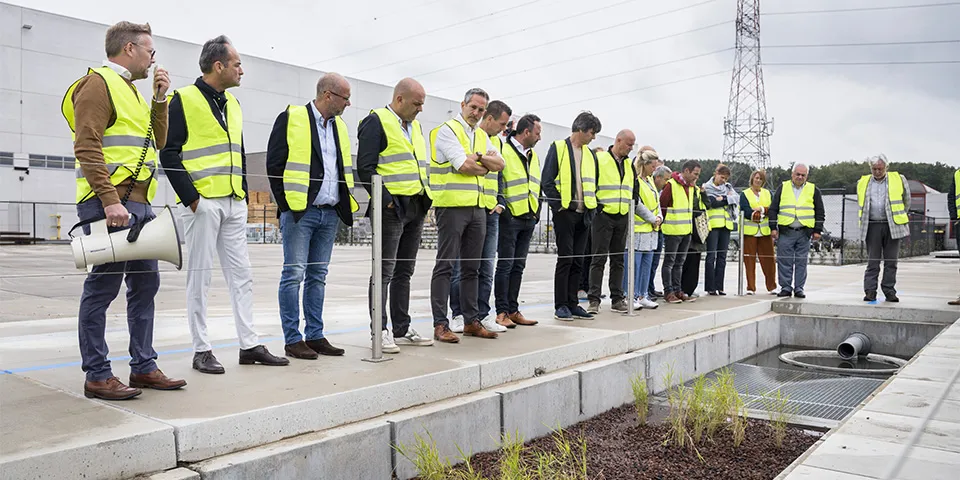
Few building materials are as widespread as concrete. It is all around us, in buildings, paved areas and streets. Yet it is often criticised as impermeable, and therefore bad for rainwater infiltration. The idea that every square metre of concrete meant one less square metre of green space also played a part. This gave Philippe Segers, CEO of Eurodal, more than enough reason to look for new, sustainable concrete solutions. The guiding principle was to manage water, green space, paving and land efficiently.
From problems to new opportunities
Together with several external companies and research institutes, Eurodal, a manufacturer of concrete slabs and floor panels, established the B’RAIN partnership. They set out to find, and succeeded in finding, a fully sustainable use for concrete that fits perfectly with the responsible management of water, green space, land and paving. What is more, concrete can now actively contribute to collecting, infiltrating and reusing rainwater, as well as to creating more and better green space in cities. In this way, old problems have been turned into new opportunities.
Innovative applications
The partners in the B’RAIN collaboration, namely Eurodal, Beton De Bonte and Tree Builders, joined forces to devise a new, sustainable and forward-looking system in which concrete plays the leading role. As individual companies, they would not have been able to offer such a comprehensive solution.
The system is based on three vertical layers: the concrete paving itself, openings in the paving for trees and plants, and space beneath the concrete for water.
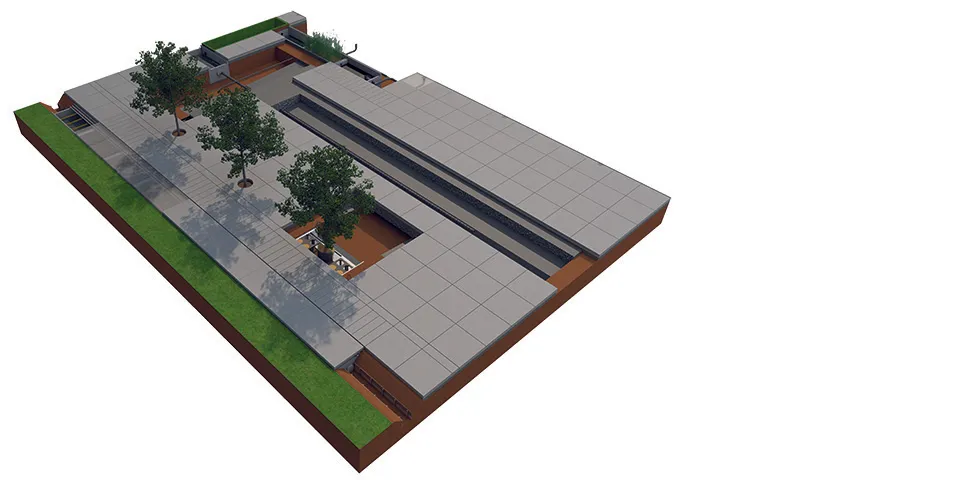
One practical application, Vélonet, makes it possible to cover existing ditches or newly dug trenches with concrete and lay a cycle path on top. Open channels with inlets are installed in the trenches, allowing rainwater to drain into them. Dividing the connected chambers into compartments makes the system suitable for sloping ground. Utility services are also installed in the trenches. This not only saves scarce space, but also avoids costly and time-consuming land expropriations.
Another application is paving large public areas such as town squares, car parks and school playgrounds. Here too, rainwater can be collected and drained away, with openings provided for greenery. Eurodal’s ‘Hydrops 3.0’ consists of interconnected concrete chambers beneath the paving, where the water is filtered to remove silt before being released slowly into the soil. Some of the purified water is supplied to trees and plants.
Greener cities
Trees in urban settings present a different challenge. As the soil becomes more compacted, their roots seek water and oxygen near the surface, often lifting and damaging the surrounding paving, which in turn leads to extra costs. The solution is to install tree pits beneath the concrete paving.
Below ground, these provide secure root-ball anchorage, root guidance, irrigation facilities and deep aeration. This prevents damaging root heave and allows trees to grow healthily in ideal conditions. It is a solution that is as ingenious as it is simple, and offers an answer to global warming, which is placing ever greater pressure on the health of urban trees. Our cities can only become greener as a result.
Eurodal showcases these sustainable, forward-looking solutions in its own inspiration park and demonstration area in Grobbendonk.
Question about this story? Ask your question
Keep following this
Get an email when a new story is published. No account needed.
- SubjectProduct information