Gravier d’Or® dolomite shines beneath your feet
Text Luc OphalsImage Dolomies de Villers-le-Gambon
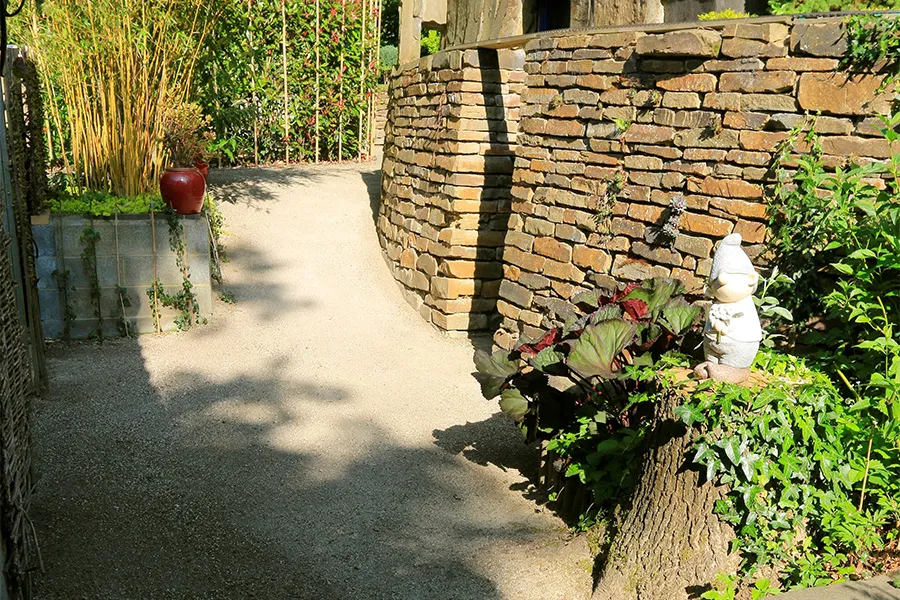
Paths and roads with a golden glow
Dolomite has been quarried at Merlemont since the late 19th century. This rock forms through the very early transformation of limestone, accompanied by recrystallisation, which gives the gravel certain properties. Dolomite occurs here in two forms: grey and zebra dolomite, used exclusively to make fertilisers, and yellow dolomite, mainly used as decorative gravel for driveways and paths in parks and gardens. With its attractive pastel shades, yellow dolomite, marketed under the brand name Gravier d’Or®, is ideal for creating elegant, durable paved surfaces.
A little history
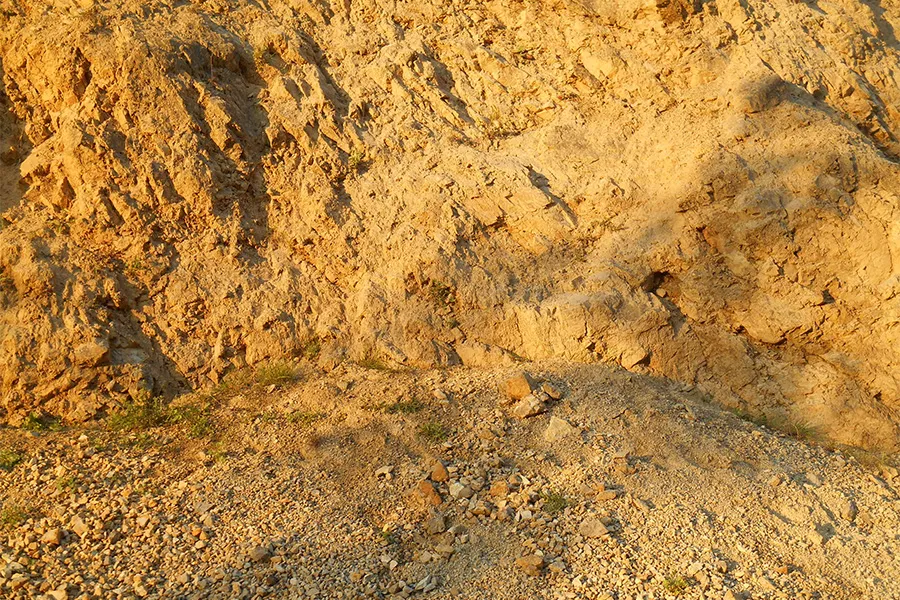
Industrial dolomite extraction in the Merlemont area, in the province of Namur, began in 1883. The public limited company La Dolomie de Merlemont was founded in 1898, followed by Dolomie de Villers-le Gambon in 1907. At the time, the main markets were refractory bricks and lime kilns, steelworks and agriculture. But in the 1950s, the market expanded to include stonework for central reservations and paths in parks and gardens, with the product receiving considerable attention, particularly at the 1958 World’s Fair. Since 1988, the site has been owned by two shareholders, one of which is the Lhoist group, which manages it. Dolomies de Merlemont and Dolomie de Villers-le-Gambon operated alongside each other for a time. Since 2018, all activities have been carried out under the name Dolomie de Villers-le-Gambon.
Quarrying the deposit
The dolomite deposit is quarried at a rate of 400,000 tonnes of ore a year, two thirds of which is grey dolomite and one third yellow dolomite. The rock’s hardness means it is extracted using explosives. The stone is crushed and screened at the company’s historic plant, a kilometre from the quarry. Emmanuel Boland, operations manager: “With our team of ten and the involvement of a subcontractor for drilling, transport, loading and processing (around fifteen additional people), we sell dolomite to private customers, park and garden contractors, local authorities and merchants. Mainly in Belgium and the Netherlands. We are the only producer of Gravier d’Or® dolomite, a stone with three highly attractive properties: an appealing ochre to light beige colour, good natural hardness, and the ability to self-bind after use.”
Three grades
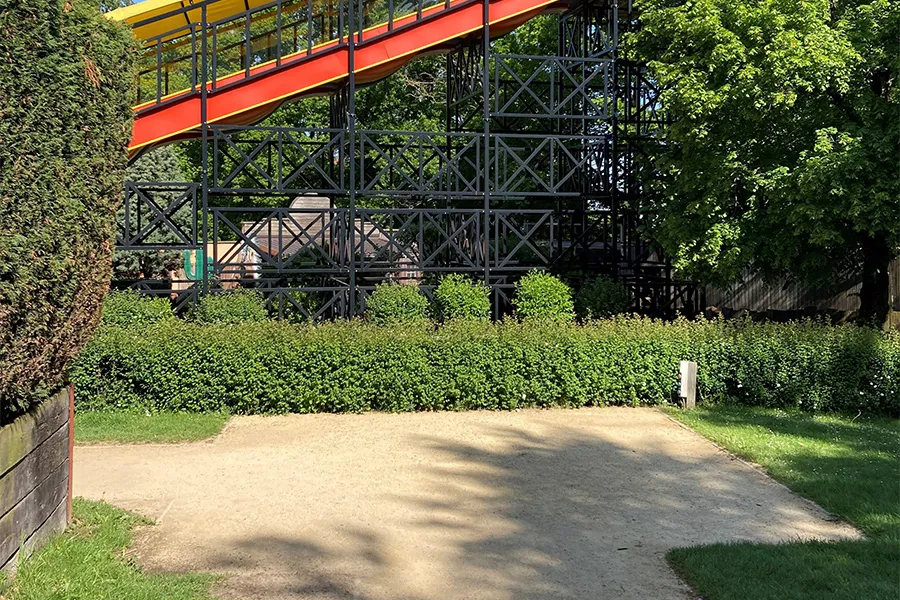
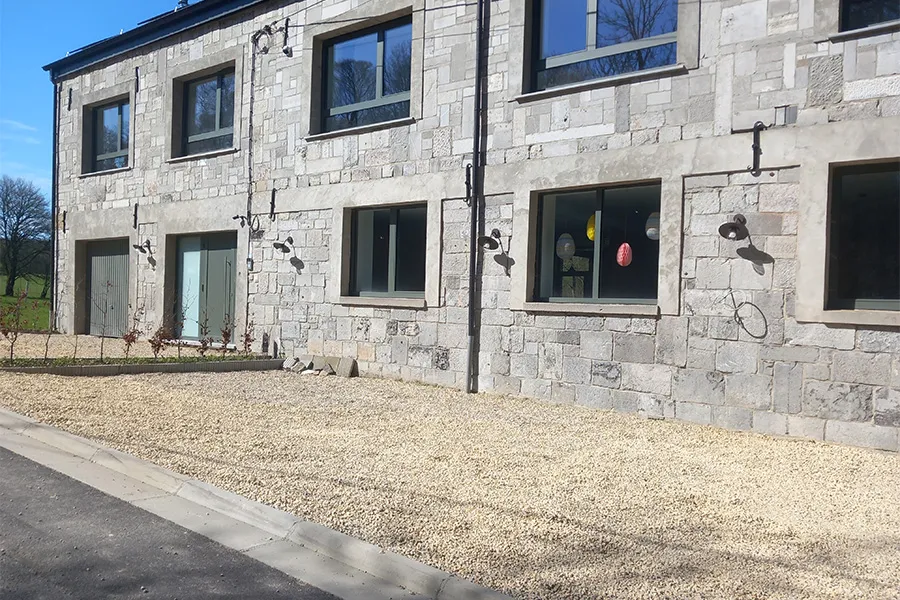
“Yellow dolomite is perfectly suited to paving in parks and gardens. It offers several attractive visual and practical benefits. Yellow dolomite is available in three grades: 0-5 mm, 0-15 mm and 5-15 mm. The first advantage of Gravier d’Or® dolomite is its appearance: the 0/5 and 0/15 mm grades have a warm ochre colour that always works well with other natural colours. In the 5-15 mm grade, the colour shifts towards beige, with golden tones depending on the amount of sunlight. This is due to the range of component shades and the surface texture. That same texture also keeps the gravel bright in the rain. It is also a permeable material, allowing rainwater to seep into the ground. Stone is easy to lay and adapts well to curves and irregular landscapes. Finally, the 0/5mm and 0/15mm grades have a slight self-binding effect when exposed to rainwater, due to the recrystallisation of carbonates. This makes the material more durable and more resistant to erosion,” explains Emmanuel Boland. There is also a technique for creating a bound surface from Gravier d’Or ® 0/5mm while retaining its colour, using plant-based oils (GraviLyn®).
Restoring the site
The company takes the rehabilitation of the site very seriously, with particular attention to biodiversity. Quarries have the distinctive ability to rejuvenate and clear an environment, providing many plant and animal species with a habitat they can no longer find elsewhere. These include orchids, birds of prey, reptiles, amphibians and numerous insects. At Merlemont, thanks to the area’s biodiversity and the modest size of the extraction pits, these species quickly colonise the site itself. The restoration plan aims to encourage and sustain this process. The oldest pits, south of the deposit, have already been converted into a nature reserve, which the company manages on a daily basis.
Question about this story? Ask your question
Keep following this
Get an email when a new story is published. No account needed.
- SubjectProduct information