Natural, biological or physicochemical? The truth about swimming pond systems
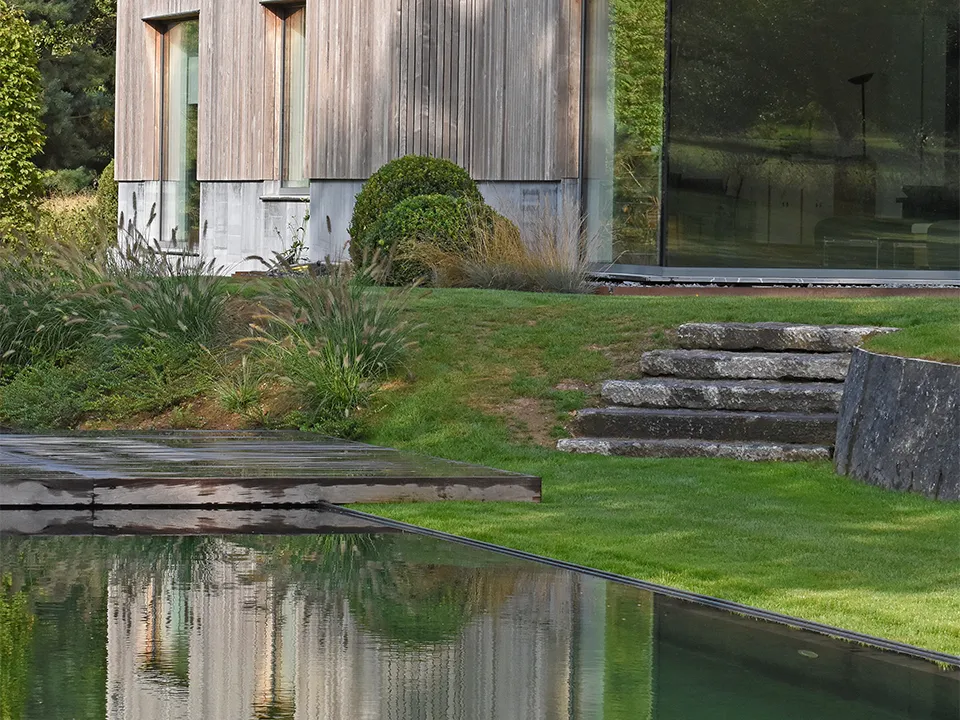
Natural swimming ponds, bio pools, hybrid pools… Over the past few years, there has probably been some confusion about the different systems.
In this article, we summarise the main systems and set them out in a logical order, from the 100% natural swimming pond to the physicochemically treated pool.
Text Guido Lurquin MSc & ir. Stijn Wulleman | Image Distri Pond
Natural swimming pond
No substances are added to the water in natural swimming ponds. Filtration takes place in large planted reed beds. There are several systems available.
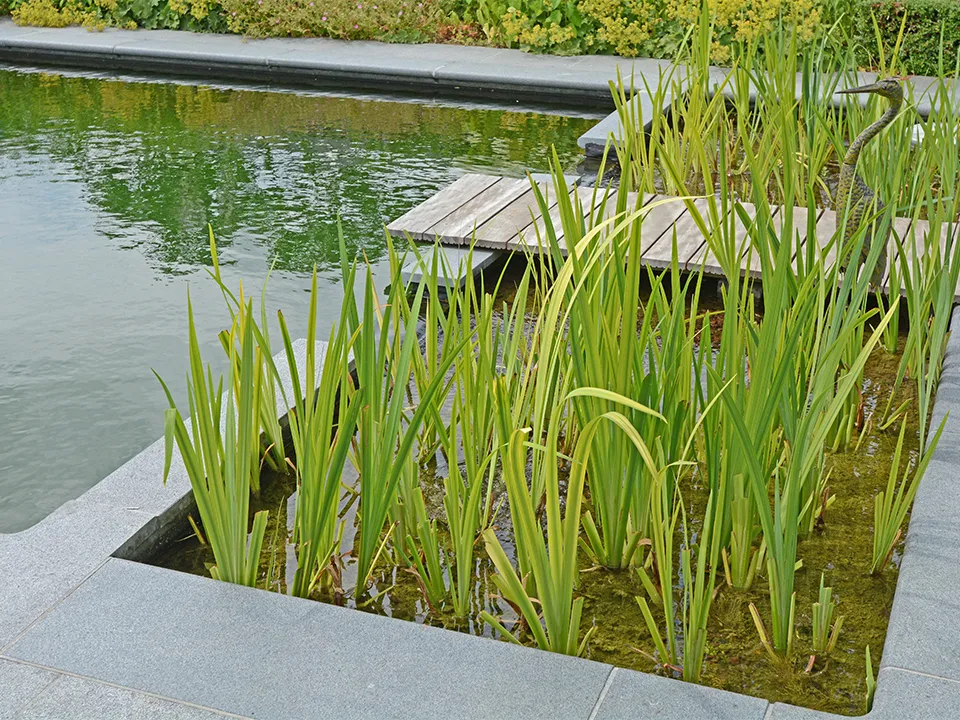
Downflow reed bed
The oldest system used in natural swimming ponds is the downflow principle. Here, the water is biologically purified from top to bottom by the plants and a layer of substrate.
Ideally, the entrance to the reed-bed zone is located on the north-east side of the swimming pond. In this position, the prevailing south-westerly winds help carry dirt particles towards the reed bed. All the pollutants remain in the system and are processed by nature.
This system has very low energy consumption, and the reed-bed area provides an interesting pond habitat. It is therefore the most ecological swimming pond option.
Upflow reed bed
Where more pollution is expected from the surrounding area, for example near large trees, roads or industry, and clogging of the reed bed is to be avoided, the upflow principle is used. Here, the water moves in the opposite direction, from bottom to top, and first passes through a bow sieve or mechanical pre-filter. This removes some of the pollutants from the water, after which nature takes care of the rest.
Energy consumption remains low with this system, and the planted zone once again provides an interesting pond habitat. As the reed bed is protected from pollution, it will last longer.
Multi-chamber filter with reed-bed zone
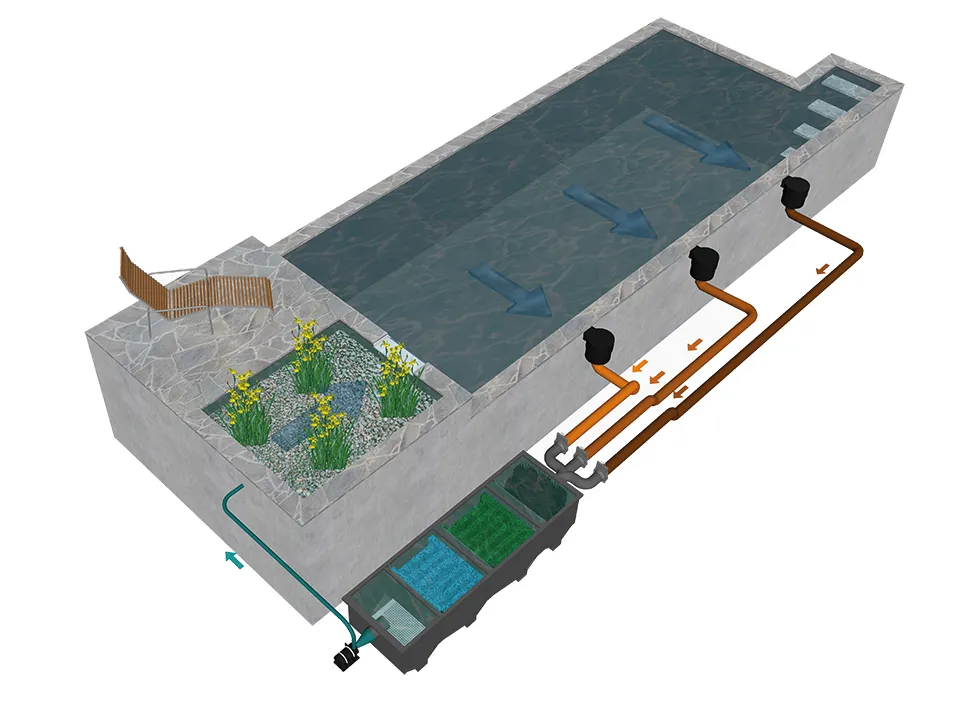
In a system combining a multi-chamber filter with a reed bed, water moves laterally or vertically through the planted filter bed. Water flows out of the swimming zone via skimmers and then passes through a multi-chamber filter, made up of successive chambers containing various filter media, from coarse to fine. A pump then sends the pre-filtered water through the planted reed-bed filter zone.
Energy consumption is also low with this solution, and the planted zone provides an interesting pond habitat. Much of the pollution is filtered out before the water flows through the reed bed.
Biological swimming pond
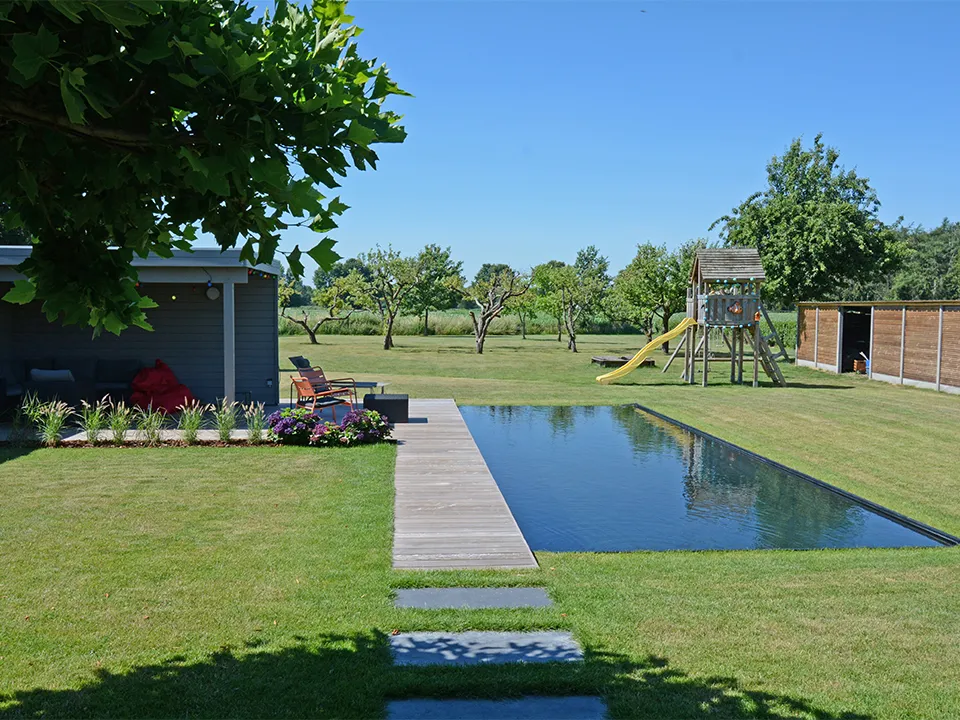
In biological swimming ponds, mechanical and biological processes are accelerated, allowing efficient filtration with smaller volumes. This is achieved by the measured addition of minerals and bacteria, and the process can be partly automated. There is no reed-bed zone.
For example, combining a drum filter with a moving bed and a UV filter creates an efficient mechanical and bacteriological filter. Even very small solid particles are immediately captured from the
water.
This system is very compact, but falls into a higher price bracket. The water can be easily monitored using Aquatic Science’s Spintouch water analysis.
Physicochemical filtration
In physicochemically filtered swimming ponds, filtration is less natural, and the water is disinfected using hydrolysis and UV radiation. There is an important difference between physicochemical filtration with and without the addition of salt.
Without the addition of salt
This system deliberately uses no added salt, but does use copper ionisation combined with pH control. A planted reed bed consumes residual substances and provides a natural appearance. An additional phosphate filter is strongly recommended to limit algal growth.
In correctly functioning systems, concentrations are so low that they pose no health risk to bathers, although it is advisable to measure copper levels frequently.
The system’s equipment is installed in a garden shed or plant room. It falls into a higher price bracket.
With the addition of salt
A physicochemically controlled pool with added salt goes one step further. In this case, disinfection is a deliberate choice. As salt is added to the water, low-conductivity salt electrolysis takes place, producing chlorine. This type of pool is therefore unsuitable for fish or plants, meaning that a reed-bed zone or planted filter cannot be incorporated. In short, this is no longer a swimming pond, but a swimming pool. Many so-called “hybrid pools” also fall into this category.
The use of salt electrolysis requires some care with the materials used. EPDM or TPO waterproofing membranes can be affected, for example, and 316 stainless steel is preferable to 304 stainless steel.
The system’s equipment is installed in a garden shed or plant room.
Biofilm
In swimming ponds, it is impossible to rule out the presence of a biofilm on the walls. In fact, this biofilm is absolutely essential to the proper functioning of the natural system.
Heating
In principle, all systems allow some form of supplementary heating, although it is advisable not to overdo it. It is better to minimise heat loss as much as possible, for example by using HeatCover. This liquid, invisible cover reduces evaporation and heat loss without detracting from the pond’s attractive, natural appearance.
Question about this story? Ask your question
Keep following this
Get an email when a new story is published. No account needed.
- ThemeWater and hard landscaping in the garden
- SubjectGarden maintenance